Bottle Typing/Diagnostic Shapes
Liquor/Spirits Bottles
HOME:
Bottle Typing/Diagnostic Shapes:
Liquor/Spirits Bottles
Click here to move to the Organization & Structure Summary.
 Liquor
of all types - bourbon, rye, gin, cognac, scotch, etc. - was bottled in a
wide variety of bottle shapes and sizes ranging from small flasks that
held a few ounces to demijohns and carboys that held gallons. As
with virtually all of the bottle type categories to follow, liquor bottle
diversity is staggeringly complex in depth and variety. The pictures
on this page
show just a small bit of this variety. However, there are
definitive trends in shapes that mark a bottle as very likely to have been
used primarily or originally as a container for high alcohol spirits
intended for internal consumption, "medicinal" or otherwise.
Liquor
of all types - bourbon, rye, gin, cognac, scotch, etc. - was bottled in a
wide variety of bottle shapes and sizes ranging from small flasks that
held a few ounces to demijohns and carboys that held gallons. As
with virtually all of the bottle type categories to follow, liquor bottle
diversity is staggeringly complex in depth and variety. The pictures
on this page
show just a small bit of this variety. However, there are
definitive trends in shapes that mark a bottle as very likely to have been
used primarily or originally as a container for high alcohol spirits
intended for internal consumption, "medicinal" or otherwise.
Alcohol was of course an important ingredient in many other products also, ranging from wine, champagne, beer, and porter to most patent and proprietary medicines, bitters, and tonics to even preserved fruits. This section of the "Bottle Typing/Diagnostic Shapes" page just covers liquor bottles where the contained product was high in alcohol (20%+) and the intended use was not primarily medicinal - or at least the acknowledged medicinal utility was of secondary importance. For example, even though Hostetter's Stomach Bitters contained as much as 43% alcohol (86 proof!) during the early 1900s, it's primary intent was medicinal though undoubtedly many people who used this very popular product did not have self-medication in mind (American Medical Assoc. 1921). In addition, various straight liquors were thought to be therapeutic for various ills - gin for the kidneys, rum as a cure for bronchitis, and Rock and Rye for the symptoms of the common cold (Powers 1998). Whiskey was often labeled as - and sometimes even embossed - "For Medicinal Purposes Only" as early as the mid-19th century - long before National Prohibition took effect in January of 1920 (Wilson & Wilson 1968). To be fair, ethyl alcohol was (and is) one of the better preservatives for products intended for internal consumption or external use. These examples help point out the vague line that existed between liquor/spirits and medicinal products during the 19th and early 20th centuries.
|
|
Though not quite on a par with the anti-slavery movement of the 19th century, temperance was a very significant morally based social movement in the U.S. and had its roots in the still pervasive damage done to some individuals and their families by the improper use of alcohol. To quote an important work on the subject: "For many observers of American Life the Temperance movement is evidence for an excessive moral perfectionism and an overly legalistic bent to American culture." This is a pervasive thread that still exists in current American politics and culture in aspects of human behavior well beyond just alcohol (Gusfield 1970). The growing strength of the Temperance movement and rising anti-alcohol fervor during the late 19th and early 20th centuries led to the passage of ever increasing restrictions on the manufacture and sale of alcoholic beverages. The famous (or infamous depending on perspective) Anti-Saloon League was primary force doggedly pursing the move towards the banning of alcohol and one of the first the successful single-interest pressure groups in the U. S. (Okrent 2010).
The power of the Temperance movement culminated in the addition of the 18th Amendment to the Constitution on January 16th, 1919; the amendment written to take effect one year after ratification, i.e., January 17th, 1920. National Prohibition, however, was already the law of the land through Congressional passage - over a presidential veto - of the National Prohibition Act (aka the Volstead Act) on October 28th, 1919 which took effect immediately, although existing stocks could be sold through the January 16th, 1920 date. There were, of course, various exceptions allowed under the law for "medicinal" products containing alcohol as well as sacramental wines (Okrent 2010). Although certain elements of the Volstead Act were loosed up (e.g., 3.2% beer was legal to sell again) beginning in April of 1933, repeal of the 18th Amendment came in December of 1933. With repeal, liquor was required to be sold only in bottles; bulk sales in casks was prohibited in an attempt to exert tighter controls and prevent a resurgence of anything resembling the old time saloon. In January of 1935,- federal legislation took effect prohibiting the resale or use of used liquor bottles and required that the following statement be embossed on them: FEDERAL LAW FORBIDS SALE OR RE-USE OF THIS BOTTLE (Busch 1987); see the picture to the above right. (It should be noted that implementation of this requirement began in late 1934, so some bottles made that year will have the noted embossing.) This regulation was repealed in 1964 giving an effective dating tool of 1935 to the mid 1960s for this diagnostic feature (Munsey 1970). Be aware however that for some years after 1964 liquor could still be found in bottles with this embossing since not all liquor producers switched immediately to new bottles due to the expense of new molds or to deplete an existing supply of bottles (Ferraro 1966). Bottles known to date as late as 1974 still had that inscription on them; click 1970s liquor bottle to see an example which is also covered later on this page.
 (Note on Canadian liquor laws:
Canada followed a similar trend as the U.S. in the gradual implementation
of alcohol prohibition with the various Province's going "dry" between
1901 and 1917, though there was never a "national prohibition" passed in
Canada. By time National Prohibition was fully implemented in the U.S. in
January of 1920, the only area north of Mexico that was not totally "dry"
was the Province of Quebec (Unitt 1972).)
(Note on Canadian liquor laws:
Canada followed a similar trend as the U.S. in the gradual implementation
of alcohol prohibition with the various Province's going "dry" between
1901 and 1917, though there was never a "national prohibition" passed in
Canada. By time National Prohibition was fully implemented in the U.S. in
January of 1920, the only area north of Mexico that was not totally "dry"
was the Province of Quebec (Unitt 1972).)
The push for individual State and eventually National Prohibition came right at the time (1910s) that bottle makers were making the transition from mouth-blown to fully machine-made bottles. It is an almost absolute fact that if an American made liquor bottle is mouth-blown it pre-dates National Prohibition. It is largely true, though not nearly absolute, that if a liquor bottle is machine-made it dates from or after Prohibition. Prohibition makes a very convenient dating transition point for liquor bottles which is not available for other types of bottles. However, there were some machine-made liquor bottles and flasks that most definitely pre-date Prohibition. For example the labeled, colorless, flask (with contents) pictured to the left is actually dated on the tax seal as having been bottled during the fall of 1919 which is just weeks before National Prohibition fully took effect in January 1920. It is machine-made and a commonly encountered style of liquor flask that can date from before, during, and possibly, just after Prohibition (see the "Dandy Flasks" section later on this page).
NOTE: Attached to the "Bottle
Types/Diagnostic Shapes" grouping of pages is a complete copy of a never re-printed, 280
page, 1906 Illinois Glass Company bottle catalog scanned at two pages per
JPEG file. Click
1906 IGCo. Catalog to access the page that links to all the scans of this
very useful catalog. Liquor bottles are listed primarily on pages 118-177.
|
Bottle
Typing/Diagnostic Shapes:
-Decorative flasks -Masonic flasks -Historical flasks -Calabash bottles -Agriculture, Commerce, and Transportation theme flasks -Other Figured flasks
Cylinder styles
Square/Rectangular styles
Flask styles (not considered "figured")
Other Miscellaneous shapes/styles
The array of references used to support the conclusions and estimates found here - including the listed dating ranges - are noted. Additional information and estimates are based on the empirical observations of the author over 50 years of experience; this is often but not always noted. Various terminology is used in the descriptions that may be unfamiliar if you have not studied other pages on this site. If a term is unfamiliar, first check the Bottle Glossary page for an explanation or definition. As an alternative, one can do a search of this website. To do a word/phrase search one must use the "Search SHA" boxes found on many of the main SHA web pages, including the Research Resources page (upper right side of that page) which links to this site. The Historic Bottle Website (HBW) has no internal search mechanism so be aware that when running a search one will also get non-HBW response links to other portions of the SHA site. |
|
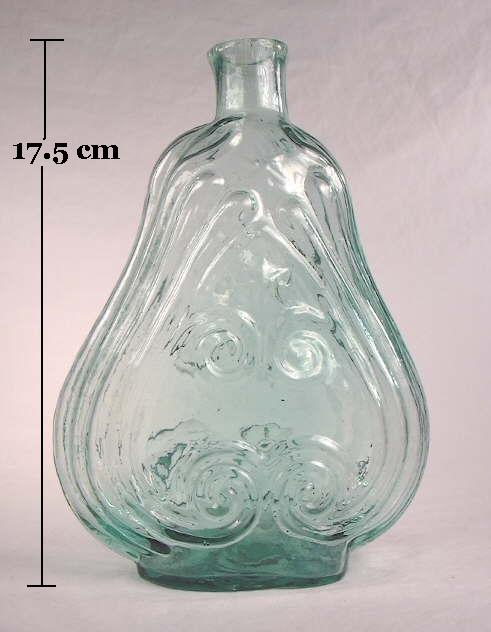
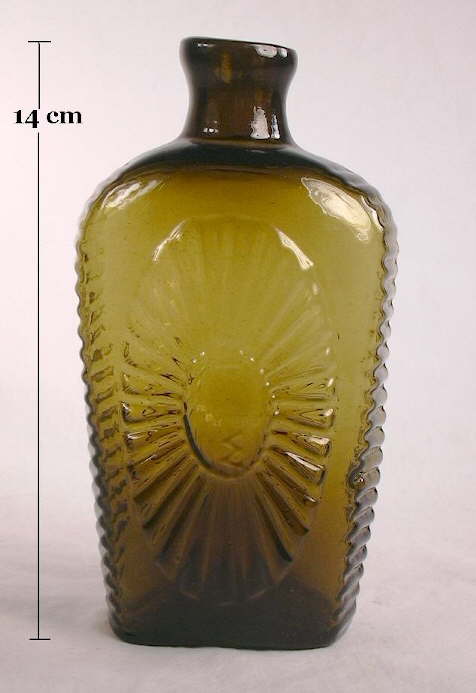
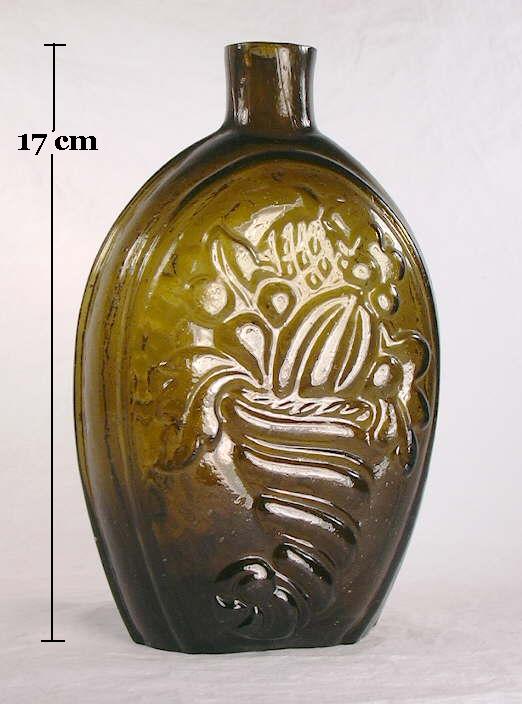
Generally following McKearin & Wilson (1978), figured flasks are loosely categorized in this section into the following groups: Decorative (e.g., scroll [a grouping of colorful scroll flasks to the above right], sunburst, cornucopia, geometric designs); Masonic; Historical (emblems/symbols of the U.S., heroes and celebrities, Presidential candidates, shield & clasped hands); Agriculture, Commerce, and Transportation; and Others (sports, Pike's Peak). Figured flasks also include calabash bottles (example below), which are covered separately here because of their distinctive shape, and some flasks that fit the form description but are just embossed with lettering, i.e.,, glassmaker or purchaser name/location. Unlike most other types of liquor bottles which are generally more common without embossing, figured flasks are by definition embossed since the embossed motifs and molded designs are what defines them as figured flasks, though many shapes are also unique to this group (e.g., scroll flasks, calabash bottles). Unembossed flasks with shapes similar to some of the later (1860s primarily) figured flasks are considered generically in the "Flask (not considered figured)" category. The figured flasks described here represent a small cross-section of the hundreds of different types made during their heyday. These type items are occasionally found on historic archaeological sites though usually as fragments since they were not usually discarded until broken. Most of the classification and dating information for this section is from McKearin & Wilson's epic work "American Bottles & Flasks and Their Ancestry" (1978). This book is the source of information on figured flasks and contains by far the most comprehensive listing (with illustrations) and is the accepted classification system for figured flasks. The listing of figured flasks - pages 521-677 - was an update and expansion to the original listing found in McKearin & McKearin (1941). An alternative classification for figured flasks in McKearin & Wilson, which is pertinent to their dating, is a section entitled "Bottle Form or Shape Groups" (pages 512-517). Here the authors divide figured flasks into 9 distinct "Form Groups" and includes dating ranges for when that form group was first produced. The book also covers most other types of 18th and 19th century American bottles and is an almost mandatory reference for serious students of American made bottles of the 18th and 19th century. Note: Because of the beauty - and possibly the intrinsic value - of figured flasks, many have been reproduced at various times during the 20th century. Some of these reproductions are very hard to discern from originals to the inexperienced eye. These reproductions are not covered here but are discussed in McKearin & Wilson on pages 678-696, through the 1978 publication date. The bottles pictured in this section are all early to mid-19th century originals.
|
Return to the top of this page.
|
There is a wide variety of liquor/spirits bottles in which the bodies are round in cross-section, i.e., cylindrical. These types of bottles vary in size and design substantially, but all share the fact that they are round when looking straight on at the base. The evolution of the cylinder liquor bottle is generally from wider and squattier to narrower and taller as time progressed (Wilson & Wilson 1968; Jones 1986). (Note: The evolution of spirits/wine bottles is discussed and illustrated in McKearin & Wilson (1978) on pages 205-221.) The following bottles represent some of the more common shapes of cylindrical liquor bottle progressing in general from oldest to newest. As with all the bottle types described on this site, there is almost endless variations on any shape theme so a user should not get too caught up in subtle details, though admittedly some subtle details can be very diagnostic; these are noted where possible.
|
Return to the top of this page.
|
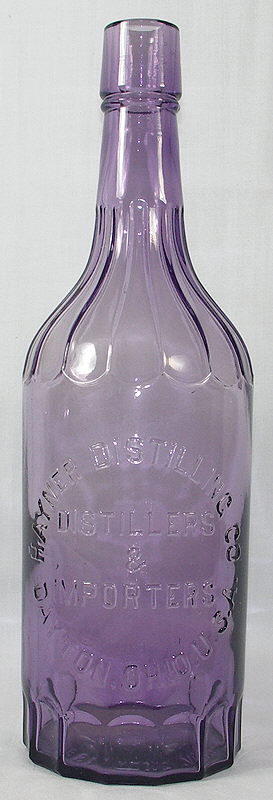
Like the cylinder liquor bottles above, there is a large array of liquor bottles that are square or rectangular in cross-section. These bottles varied in size and design substantially, but all share the fact that they are square or rectangular when looking straight on at the base. The following bottles represent some of the more common shapes of square/rectangular liquor bottles progressing from the generally oldest styles to newest. As with all the bottle types described on this site, there is almost endless variations on any shape theme so a user should not get too caught up in subtle details, though admittedly some subtle details can be very diagnostic; these are noted where possible.
|
Return to the top of this page.
|
Flask Styles (not considered "figured") Flasks of widely varying shapes and sizes were a very common container for spirits of all kinds, originating in the need for a traveling bottle. A flask is a bottle originally designed to be portable and easy to carry, which is typically oval to a rounded rectangle in cross-section, and laterally compressed on two sides. Flasks are most often associated with varying types of spirits, though they were used for some other liquid products like medicines and bitters (Jones & Sullivan 1989, Ring & Ham 1998, empirical observations). Though the "flask shape" can be found in a multitude of sizes; on this website flasks are considered to have a capacity of about 16 oz. or less which is a more or less the upper limit of a pocket or "portable" size. The following bottles represent some of the more common shapes of spirits/liquor flasks progressing in general from oldest to newest. As with all the bottle types described on this site; there is almost endless variations; crossovers; and hybrids on any shape theme with flasks. Given this a user should again not get too caught up in specific details.
Between the era of the "Pitkin" style flasks above (late 18th through the first third of the 19th century) and later styles of spirits/liquor flasks covered below (1860s and after) the Figured Flasks were dominant. These were previously covered above as a separate category due the ubiquity and the historical significance of that grouping. See the Figured Flasks section of this page for coverage of that spirits bottle category.
|
 Picnic/Jo
Jo
Flasks:
Concurrent with the popularity of shoo-fly flasks,
were the equally popular "picnic" flasks. They are also
sometimes called
"pumpkin seed" flasks by collectors based on some resemblance to
that seed.
However, based on a review of a large number of the glass makers catalogs
listed on the
Reference Sources/Bibliography page, there is no
evidence that glass makers themselves called these flasks "pumpkin seeds."
In fact, at least one glassmaker embossed the name "Picnic" on the flask,
as pictured below. This picnic flask is a "half-pint" (maybe 5 oz.)
dating from around 1900 in an mildly unusual aqua color (photo from
eBay®).
As noted earlier, bottle makers would often call the smaller capacity -
smaller than the nominal name size - bottles "scant" capacities and the
full size "full measure" bottles (Wightman 1900). The picnic name
apparently comes from fact that these flasks were just the right size for
taking on outings. Picnic flasks seem to appear first during the
late 1870s, with the peak of popularity from about 1890 to the mid
1910s. Picnic/Jo
Jo
Flasks:
Concurrent with the popularity of shoo-fly flasks,
were the equally popular "picnic" flasks. They are also
sometimes called
"pumpkin seed" flasks by collectors based on some resemblance to
that seed.
However, based on a review of a large number of the glass makers catalogs
listed on the
Reference Sources/Bibliography page, there is no
evidence that glass makers themselves called these flasks "pumpkin seeds."
In fact, at least one glassmaker embossed the name "Picnic" on the flask,
as pictured below. This picnic flask is a "half-pint" (maybe 5 oz.)
dating from around 1900 in an mildly unusual aqua color (photo from
eBay®).
As noted earlier, bottle makers would often call the smaller capacity -
smaller than the nominal name size - bottles "scant" capacities and the
full size "full measure" bottles (Wightman 1900). The picnic name
apparently comes from fact that these flasks were just the right size for
taking on outings. Picnic flasks seem to appear first during the
late 1870s, with the peak of popularity from about 1890 to the mid
1910s.
The color of picnic flasks is dominated by clear or colorless (sometimes with a pinkish, amethyst, or faint straw tint); aqua and shades of amber are much less common; any other color is very unusual. Click picnic colors to view an image of the array of different glass colors that are possible in this style of flask. This photo also shows the finish variety that can be found, which is relatively limited. (Image courtesy of Garth Ziegenhagen.) The typical picnic finish is the double ring, though the brandy, straight brandy, bead, oil, and even internal and external screw threads were utilized on occasion. Click pint picnic flask with continuous external screw threads to see a ca. 1900-1910 mouth-blown example with the cap in place (it has a ground finish rim). Click screw thread close-up to see a close-up which shows that the glass under the cap does not have the slight pinkish tint that the remainder of the bottle exhibits, which has been exposed to daylight. (See the Bottle/Glass Colors page for more information on sun colored amethyst bottles.) Like the shoo-fly flasks, picnic flasks were primarily used for various spirits though they have been noted with labels/embossing for other products including Jamaica ginger (high alcohol medicine - click C. H. Eddy & Co. / Jamaica Ginger / Brattleboro, VT. to view a picture of a picnic shaped, embossed Jamaica ginger), various medicinal products, tea and flavoring extracts, and occasional other non-carbonated liquids like bicycle lubricating oil (Thomas 1974).
The amber "pint" (10-11 oz.) picnic flask pictured to the right is a relatively early example that dates from between about 1885 and 1890 (Thomas 2002). It also has a crudely tooled double ring finish, lacks air venting, and was blown in a cup-bottom mold like virtually all picnic flasks. It is embossed HILDEBRANDT, POSNER & CO. / (intertwined company initials) / S. F. (San Francisco, CA.). and was an early product from this large West Coast liquor company which was in business from from 1884 to 1918 (Thomas 1974, 2002). Amber is a relatively uncommon color for picnic flasks, but was occasionally used during its popularity range (late 1880s to mid 1910s). Click on the following links to see other view pictures of this flask: base view; side view; close-up of the shoulder, neck, and finish. Additional images/information on picnic style flasks:
Dating summary/notes: The picnic flask appears to have originated in the late 1870s and were produced well into the 20th century, including by automatic bottle machines. Specifically:
|
 Barrel flasks:
These flasks are very distinctive in shape and a fairly common item during the
late 19th and early 20th centuries. These flasks are more or less a
flattened oval in cross-section with more flattening on the label panel
side than the other. The typical conformation is vertical barrel
staves around the majority of the bottle, bound with two sets of three hoops. The
reverse has a rectangular label panel, though sometimes embossing is found
inside this panel (example pictured to the right below). Barrel flasks:
These flasks are very distinctive in shape and a fairly common item during the
late 19th and early 20th centuries. These flasks are more or less a
flattened oval in cross-section with more flattening on the label panel
side than the other. The typical conformation is vertical barrel
staves around the majority of the bottle, bound with two sets of three hoops. The
reverse has a rectangular label panel, though sometimes embossing is found
inside this panel (example pictured to the right below).
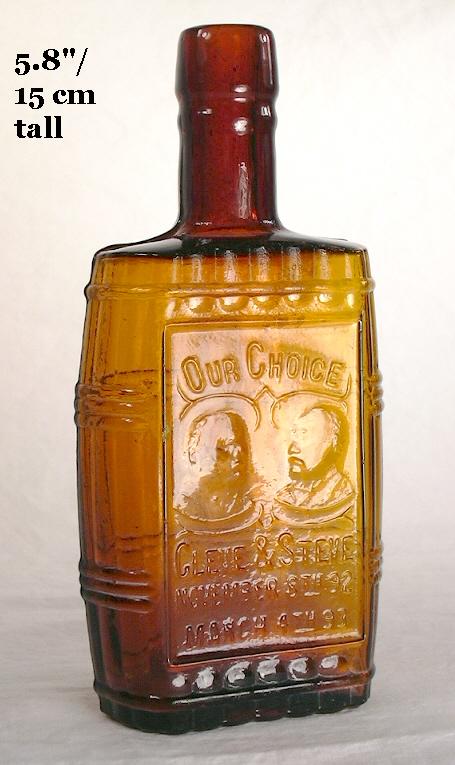
These flasks appear to have been made by at least several different American glass manufacturing companies and were possibly also produced by foreign glass makers. Barrel flasks are listed in the earlier Illinois Glass Company catalogs (1903-1908) but disappeared by the 1911 edition giving some idea of the termination date for the style (IGCo. 1903, 1911, 1920). Barrel flasks appear to be virtually always mouth-blown with tooled or improved tooled brandy/straight brandy finishes. (Machine-made examples have not been observed but are possible.) The finish on these flasks - particularly the pint size - were often designed to accept a club sauce type stopper and shell cork. Only the pint and half-pint (actually 12 and 6 ozs. respectively) sizes have been noted, though other sizes are possible. Colors are varied, with aqua and colorless the most common, though shades of amber, green, and even cobalt blue have been observed (empirical observations). These flasks were usually blown in cup-bottom molds and are likely air vented, though the vent marks appear to be well hidden by the body design on the flasks pictured here.
The amber half-pint barrel flask to the right was produced during Grover Cleveland's 1892 Presidential campaign and is embossed OUR CHOICE / (two busts) / CLEVE & STEVE / NOVEMBER 8TH 92 / MARCH 4TH 93. On the reverse, superimposed over the barrel staves, is a rooster which was the symbol for the Democratic party in some Midwestern states at that time indicating that this is where these flasks were most likely produced. These flasks are listed in McKearin & Wilson (1978) as a portrait flask with the catalog number GI-124 and are one of the latest produced flasks they cataloged. Click on the following links to view more pictures of this flask: view of the reverse with barrel hoops and embossed rooster; base view; side view; close-up of the shoulder, neck, and finish. Dating summary/notes: The barrel flask type noted here appears to have originated in the mid to late 1880s and were likely produced until at least the early 1910s. Specifically (based on empirical observations):
|
 Eagle
Flasks:
The "Eagle" flask is the first of four flasks described here that were
primarily produced and popular during the first couple decades of the 20th
century. Possibly
as early as the late 1890s or more likely the very early
1900s (at the Illinois Glass Company the Eagle first appeared in
the 1906 catalog), the Eagle style of flask was developed and quickly
became quite popular. The
origin of the name "Eagle" is unknown though it likely
originated as some
glasswork's proprietary name for the shape which eventually became
generic for the style as they are listed by that name in various bottle
makers catalogs (IGCo. 1903, 1920; Obear-Nester 1922). A similar style with two
rings at the junction of the neck and shoulder was called the "Billy";
another variation called the "Comfort Oval" had one side that was concave
which allowed it to "...fit the hip pocket in comfort ..."
(IGCo. 1906; Feldhaus 1987). Unlike most
shoo-fly and picnic flasks the Eagle actually held the stated
or implied capacity more or less. This may have been a function of the myriad of consumer protection laws
-
including truth in labeling - which began to be enacted and enforced during the
era of this flask styles popularity (Young 1967). Eagle
Flasks:
The "Eagle" flask is the first of four flasks described here that were
primarily produced and popular during the first couple decades of the 20th
century. Possibly
as early as the late 1890s or more likely the very early
1900s (at the Illinois Glass Company the Eagle first appeared in
the 1906 catalog), the Eagle style of flask was developed and quickly
became quite popular. The
origin of the name "Eagle" is unknown though it likely
originated as some
glasswork's proprietary name for the shape which eventually became
generic for the style as they are listed by that name in various bottle
makers catalogs (IGCo. 1903, 1920; Obear-Nester 1922). A similar style with two
rings at the junction of the neck and shoulder was called the "Billy";
another variation called the "Comfort Oval" had one side that was concave
which allowed it to "...fit the hip pocket in comfort ..."
(IGCo. 1906; Feldhaus 1987). Unlike most
shoo-fly and picnic flasks the Eagle actually held the stated
or implied capacity more or less. This may have been a function of the myriad of consumer protection laws
-
including truth in labeling - which began to be enacted and enforced during the
era of this flask styles popularity (Young 1967).
Distinguishing features of the Eagle flask style are: the precisely vertical/parallel sides, the short base pedestal which is almost as wide as the body, the highly compressed body from front to back giving a cross section that is a very flattened oval, and the bead ring on the neck typically right above the junction of the neck and shoulder (like the pictured flasks). These flasks came in a myriad of sizes from 3 ozs. to 32 ozs., though the most popular were the pint and half pint sizes judging from the examples seen today (IGCo. 1906, 1920; Obear-Nester 1922). The finish on these flasks is almost always a brandy/straight brandy style with the bead ring collar about the same size and diameter as the lower neck ring. Rarely, the finish is an oil finish; other finish styles are, of course, possible but have not been observed (empirical observations). The Eagle flasks pictured here are embossed with SPRING VALLEY / WINE CO. / "THE BIG STORE" / 2ND & YAMHILL / PORTLAND, ORE. in a round plate, and FULL POINT and FULL 1/2 PINT on the lower front (picture below right). This company began operation in 1909 and ended business by the end of 1915 when statewide Prohibition in Oregon was passed and took effect (Thomas 1998a). These flasks have "improved" tooled finishes, multiple (5) air venting marks on both shoulders, and were blown in a cup-bottom mold - all consistent with a late mouth-blown production date (1900 to mid 1910s). These are typical shape and sizes of the Eagle flask. Click on the following hyperlinks to view more pictures of the pint flask: base view; side view; close-up of shoulder, neck, and finish.
|
 Olympia & Washington Style
Flasks:
The Olympia flask was the proprietary product of the Illinois Glass Company
(Alton, IL.). That company in 1903
proudly noted that they "take pleasure in presenting to the trade our
new Olympia Flask, in whose shape we have carefully avoided all the
objectionable features of ordinary flasks..." (emphasis theirs).
They also noted that it was "name copyrighted" with the design patented
"August 9th, 1898"
(IGCo. 1903). The flasks to the left are half-pint sized Olympia
flasks that have that patent date embossed on the base, which was typical
of the product. Since Illinois Glass was one of the largest
producing glass companies of the early 1900s, these flasks were relatively popular. Olympia & Washington Style
Flasks:
The Olympia flask was the proprietary product of the Illinois Glass Company
(Alton, IL.). That company in 1903
proudly noted that they "take pleasure in presenting to the trade our
new Olympia Flask, in whose shape we have carefully avoided all the
objectionable features of ordinary flasks..." (emphasis theirs).
They also noted that it was "name copyrighted" with the design patented
"August 9th, 1898"
(IGCo. 1903). The flasks to the left are half-pint sized Olympia
flasks that have that patent date embossed on the base, which was typical
of the product. Since Illinois Glass was one of the largest
producing glass companies of the early 1900s, these flasks were relatively popular.
Physically, the Olympia flask is a symmetrically flattened oval in cross-section with relatively flat panels on the front and back. It also tapers noticeably from the shoulder to the heel. The illustration at the bottom right corner of this box is of an Olympia flask from the 1906 Illinois Glass Company catalog which noted that the flask was made in sizes ranging from 1 1/2 oz. to 32 ozs, with five different sizes (6, 7, 8, 12, 16 oz.) available as plate molds (IGCo. 1906). Click on the illustration to see the entire page from the 1906 catalog showing this flask.
The pair of half-pint (6-8 ozs.) Olympia flasks pictured to the left above are both embossed identifying their origin as the "Log Cabin" saloon in Baker City, OR. Specifically, the left bottle is embossed with MIKE HOFF'S / LOG CABIN / BAKER CITY, ORE.; the one to the right with HOFF'S LOG CABIN / BAKER CITY / OREGON. Both flasks are half-pints that were blown in a cup-bottom plate mold (as noted in the IGCo. catalog), have tooled finishes, and are multi-air vented. These flasks were undoubtedly made by the Illinois Glass Company as both have the base embossing DESIGN PATENTED / AUGUST 9th, 1898. According to the historical record (business directories) Hoff operated his Baker City saloon from 1902 until Oregon's statewide Prohibition in 1915 with the flasks dating between 1902 and 1913 when Baker City was officially name changed to just Baker (Thomas 1998a). (Olympia flasks image courtesy of Garth Ziegenhagen.) The Washington flask pictured to the right above is embossed in a round plate UNION AVENUE EXCHANGE / HENRY HERGERT / 523 UNION AVE. / PORTLAND, ORE. It dates from 1911 or 1912 as the Union Avenue Exchange saloon was only in business for a couple years under the proprietorship of Henry Hergert (Thomas 1998a). This particular flask has an "improved" tooled brandy finish, multiple air venting marks including on the base, and was blown in a cup-bottom mold - all consistent with a manufacturing date of the 1910s. Click on the following links to view additional pictures of this flask: base view; side view; close-up of shoulder, neck, and finish. Additional images/information on Olympia/Washington style flasks:
|
 Baltimore Oval Flasks:
This is another of the flask styles most popular during the late 1890s
and first two decades of the 20th century, then largely disappeared during
National Prohibition. The Baltimore oval is rectangular in cross-section
with rounded edges. The wide front and back panels are flat as are
the sides, which are sometimes banded on these flasks. The Baltimore
Oval is similar to the next covered flask (Dandy) except more rectangular
in cross-section with distinctly flattened sides. Different
variations
of this style also existed; some of these went by names like "The Chicago" (shorter neck and more
flattened), "St. Louis Oval" (less distinctly flattened on the two large
sides), "Philadelphia Oval" (rounded on the narrow sides instead
of flattened), "The
Wheeling Oval" (front and back rounded slightly outwards),
"Pittsburg" (sic) (very similar), and likely many
others from different glassmaking companies (IGCo. 1903; Cumberland 1911). Take at look at the following pages from the
1906 Illinois Glass Co. catalog for this and similar shaped flasks: pages
156-157; 158-159; 164-165,
and
166-167. Baltimore Oval Flasks:
This is another of the flask styles most popular during the late 1890s
and first two decades of the 20th century, then largely disappeared during
National Prohibition. The Baltimore oval is rectangular in cross-section
with rounded edges. The wide front and back panels are flat as are
the sides, which are sometimes banded on these flasks. The Baltimore
Oval is similar to the next covered flask (Dandy) except more rectangular
in cross-section with distinctly flattened sides. Different
variations
of this style also existed; some of these went by names like "The Chicago" (shorter neck and more
flattened), "St. Louis Oval" (less distinctly flattened on the two large
sides), "Philadelphia Oval" (rounded on the narrow sides instead
of flattened), "The
Wheeling Oval" (front and back rounded slightly outwards),
"Pittsburg" (sic) (very similar), and likely many
others from different glassmaking companies (IGCo. 1903; Cumberland 1911). Take at look at the following pages from the
1906 Illinois Glass Co. catalog for this and similar shaped flasks: pages
156-157; 158-159; 164-165,
and
166-167.
The finishes on Baltimore Oval flasks are typically a tooled or "improved" tooled brandy or straight brandy type, though mouth-blown versions do frequently come with external screw-threads like the flask pictured below. Some larger versions of this style bottle were made with inside screw threads - see the "Rectangular Spirits Bottles" portion in the "Square/Rectangular" spirits bottle section above. These flasks also always seem to have air venting marks - often many in various places - and were blown in a cup-bottom mold; all features consistent with an early 20th century manufacture. The pair of amber flasks pictured above are pint and half-pint (true sizes) Baltimore Ovals which are embossed in a plate with GULLEY'S FAMILY LIQUOR STORE / 304-1ST STREET. / PORTLAND, ORE. Just what a "family liquor store" meant may seem strange to us these days (drinking children?), though it was likely a reference to a liquor store owned by the James J. Gulley family. It was not an uncommon designation during the early 20th century and likely was an attempt to put a more humane face on liquor sales during those volatile days of rising prohibitionist fervor. (In fact, if you run a search on the internet now one will turn up a lot of "family liquor stores" still in existence. As a side note, some liquor merchants actually bottled their products in bottles strongly identified with prescription druggist bottles. Click the following link to see a "Blake" style druggist bottle unabashedly use by a Washington, D.C. liquor seller - WM. D. Barry Reliable Family Liquor Store.) All of these GULLEY'S flasks have improved tooled finishes, multiple air venting marks on both shoulders and along the mould seams, and were blown in a cup-bottom mold; all consistent with the business dates for James Gully from 1908 to 1911 (Thomas 1998a). Click on the following links to view more images of the pint size: base view; side view; close-up of the shoulder, neck, and finish.
Dating summary/notes: The Baltimore style flasks appear to have originated in the very late 1890s or early 1900s and were popular up until sometime during National Prohibition. Specifically:
|
 Dandy
Flasks:
This fairly simple style (or variations very similar) probably went by several names (e.g., "Columbia", "Philadelphia
Oval", Mikado", "Madison", "Phoenix"), but the most commonly used name in glassmakers catalogs
-
and by collectors/archaeologists today - is the "Dandy" (IGCo. 1903,
1908, 1920;
Cumberland 1911; Obear-Nester 1922). Unlike the three flasks covered immediately above, the
Dandy style made the
leap to post-Prohibition popularity and varieties of this style
remain in use even today. These type flasks were called the "book
shape" by Canadian bottle makers (Stevens 1979). Dandy
Flasks:
This fairly simple style (or variations very similar) probably went by several names (e.g., "Columbia", "Philadelphia
Oval", Mikado", "Madison", "Phoenix"), but the most commonly used name in glassmakers catalogs
-
and by collectors/archaeologists today - is the "Dandy" (IGCo. 1903,
1908, 1920;
Cumberland 1911; Obear-Nester 1922). Unlike the three flasks covered immediately above, the
Dandy style made the
leap to post-Prohibition popularity and varieties of this style
remain in use even today. These type flasks were called the "book
shape" by Canadian bottle makers (Stevens 1979).The Dandy style is quite similar to the Eagle flask except that there is no bead ring at the junction of the neck & shoulder. Otherwise it shares the same general body shape with the vertical/parallel sides, the short base pedestal which is almost as wide as the body, and a highly compressed body from front to back giving a cross section that is a very flattened oval. Finishes of mouth-blown and early machine-made examples tend towards the brandy/straight brandy types, though mouth-blown ones occasionally are found with external screw threads and a ground rim. Later machine-made examples (1920s and later) are dominated by external screw threads, though corks are still occasionally seen in modern versions of these flasks. Mouth-blown examples of these flasks appear to all have been blown in a cup-bottom mold and are usually copiously air vented, reflecting the mouth-blown technology of the early 1900s.
On occasion, Dandy flasks were produced with a finish that accepts an inside thread stopper. The half pint, mouth-blown Dandy flask to the right is embossed TRADE / (eagle with two globes motif) / MARK / S. A. ARATA & CO. / PORTLAND, ORE. that dates between about 1905 and 1911 (Thomas 1998a). This flask has an "improved" tooled finish, multiple air venting marks including on the base, and was blown in a cup-bottom mold - again all consistent with a manufacturing date during the couple decades of the 20th century. (In fact, it is highly dateable bottles like this and the previous one that provide the support for the diagnostic features based date ranges found on this website.) Click on the following links for more pictures of this flask: base view; side view; close-up of shoulder, neck, and finish showing the inside threaded stopper in place.
Additional images/information on Dandy type flasks:
Dating summary/notes: The Dandy flask appears to have originated in the 1890s, achieved popularity in the very early 1900s, and produced through Prohibition to the present day. Specifically:
|
|
Mid-20th century spirits/liquor flasks:
There
were hundreds if not thousands of different post-Prohibition liquor flasks
produced in varying shapes and sizes through the middle of the 20th
century, and of course, to the present day. The cork and screw top
Dandy flask pictured above are typical of those made from the 1930s
through the 1950s and not unlike those in production today.
This section may be expanded in the future as time allows... |
Return to the top of this page.
|
Other Miscellaneous shapes/styles This final category for spirits/liquor bottles is a catch-all for some spirits bottles that do not fit neatly into the categories above.
|
Return to the top of this page.
|
For additional images of various labeled liquor/spirits bottles click the following link to view the pertinent section of the Labeled Bottles page. |
Again it must be stated that the category of bottles covered on this webpage (Liquor/Spirits) is very large. Like all of the bottle "typing" (typology) pages connected to the main Bottle Typing/Diagnostic Shapes page, this page just scratched the surface as to the total diversity of these bottle types. It does, however, cover the primary styles that were most commonly used and encountered within an archaeological context. This page has also somewhat emphasized mouth-blown bottles since that subject is of more familiarity to the author of this website than later 20th century, machine-made items. However, though the automated bottle production era also had incredible variety, it was not as diverse as the mouth-blown era since shape standardization and simplification was typical of machine manufacturing. Also, bottle body embossing became much less frequent on machine-made bottles and a significant amount of the diversity of the mouth-blown production era was the different proprietary embossing on essentially the same shapes of bottles.
SEARCHING THIS WEBSITE:
To do a word/phrase
or image search of this website
one must use the following Google search link:
Search the SHA/BLM Historic Glass Bottle Identification & Information
Website
(Note: Search results for this website will be just below the
final top-of-the-page Google paid ads.)
12/5/2022
Return to the top of this page.






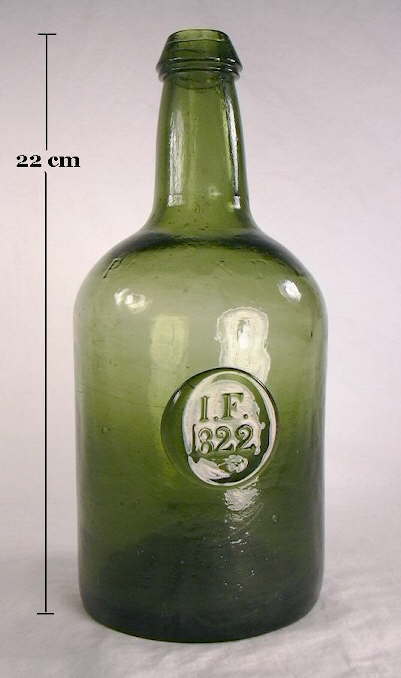


 Mountain
Malmsey Wine 1850
Mountain
Malmsey Wine 1850




 Shoo-fly
liquor type flask used for
Jamaica Ginger
Shoo-fly
liquor type flask used for
Jamaica Ginger


 F.
C. G. CO. base embossed picnic flask
F.
C. G. CO. base embossed picnic flask