|
Druggist/Prescription bottle styles
 Druggist, drugstore, apothecary, pharmacy,
pharmaceutical, and prescription bottles
- all different names used for essentially the
same identifiable group of bottles - are variable but do contain some
strongly identifiable general shapes, though size will vary greatly (Munsey
1970). The bottles covered in this section are those that were
purchased and used by local druggists and drugstores with typically only
city-wide or otherwise limited geographical distribution. For example,
the 1880s era Portland, OR. druggist bottle to the left was certainly
purchased and used almost exclusively by customers within a few miles of the druggist's store near the
Willamette River on the west side of that city. (The bottle was
actually excavated a few blocks from the embossed address.) It would be very
unusual for this bottle to be found in Nebraska, though could conceivably make it there
due to the ever increasing reach of the U. S. railroad network, i.e., the
bottle could have been carried by
a traveler. (This particular bottle is covered in more depth later, including
the fact that this
pharmacist moved to Phoenix, Arizona Territory within a year or two after this
bottle was made and used almost identical bottles for his druggist
business there.) Druggist, drugstore, apothecary, pharmacy,
pharmaceutical, and prescription bottles
- all different names used for essentially the
same identifiable group of bottles - are variable but do contain some
strongly identifiable general shapes, though size will vary greatly (Munsey
1970). The bottles covered in this section are those that were
purchased and used by local druggists and drugstores with typically only
city-wide or otherwise limited geographical distribution. For example,
the 1880s era Portland, OR. druggist bottle to the left was certainly
purchased and used almost exclusively by customers within a few miles of the druggist's store near the
Willamette River on the west side of that city. (The bottle was
actually excavated a few blocks from the embossed address.) It would be very
unusual for this bottle to be found in Nebraska, though could conceivably make it there
due to the ever increasing reach of the U. S. railroad network, i.e., the
bottle could have been carried by
a traveler. (This particular bottle is covered in more depth later, including
the fact that this
pharmacist moved to Phoenix, Arizona Territory within a year or two after this
bottle was made and used almost identical bottles for his druggist
business there.)
One note on terminology is that the term "pharmaceutical
bottle" is sometimes used in reference to the bottles used by the big
wholesale druggist and pharmaceutical firms from big cities like New York
and Chicago whose primary customers were the thousands of local druggists,
though these companies also frequently sold straight to consumers.
(Many of these pharmaceutical companies established in the 19th century were
the precursors to the large multi-national corporations still in business
today. The section on "Poison and Chemical" bottles found later on
this page briefly touches on the types of generally larger bottles commonly
used by these wholesalers.) For those interested, an nice and
concise overview of the early days of druggists is found in Preble's (2002)
book "The Rise & Demise of Colorado Drugstores 1859-1915."
Munsey (1970) divided the universe of medicine bottles into two categories
- proprietary or
ethical - which may reflect the distinction made in the early 20th century
by the American Medical Association (AMA 1912). Proprietary (aka "patent") medicines were (and are) remedial
agents available without prescription (aka "across the counter medications") and "...generally protected by secrecy, copyright, or patent against
free competition by name, product, composition, or manufacturing process"
(Fike 1987). Drugs of an ethical nature are those dispensed via a
doctor's prescription (Munsey 1970; Fike 1987). Patent/proprietary
bottles were covered earlier on this page. Druggist or prescription
bottles (the two terms used on this website) are the bottles that contained
these "ethical" products, though of course, the ethical nature of such
things has changed over time with increasing public concern and government
regulation, primarily beginning in the early 20th century.
This section covers some of the types of
bottles commonly used by local druggists/pharmacists from about the Civil War era
(1860s) to well into the 20th century. Druggist bottles, of course, go
back much farther in time - as far back as the ancient Egyptian era.
The first identifiable pharmacy bottles were Venetian bottles in the 16th
century with applied enamel labeling identifying them as such (Munsey 1970).
(Note: For some information on early American pharmaceutical bottles,
see Hume's (1991) book "A Guide to Artifacts of Colonial America"
which has some
good history and illustrations (with dates) of early pharmaceutical bottles.)
|
One of the best references on the history of
druggist/prescription bottles is "History of Drug Containers and Their Labels"
by George Griffenhagen and Mary Bogard (1999). This is a fantastic overview on
the history of druggist or pharmaceutical containers including poison bottles,
shop furniture, and much more. Also includes a large listing of the makers
markings found on druggist bottles.
Published by the American Institute of
the History of Pharmacy (AIHP),
Madison, Wisconsin. This book may
still available from the AIHP through the
mail; visit the following link for more
information:
http://cms.pharmacy.wisc.edu/aihp/order |
This section is divided into four main sections based
on general cross-section shape of the bottles: round, square, rectangular,
and oval. Within these four groups there was a wide array of
proprietary and patented shape variations available from different glass
companies. Some of these different shapes - which usually had
proprietary names attached - are covered in the sections below. A
fifth section is also included at the end that covers what were known as
"shop furniture," i.e.,, larger (up to several gallons), generally glass
stoppered, bottles and jars that were used by druggists to store bulk
substances (Whitall Tatum 1880; Illinois Glass Co. 1903).
A fair amount of detail has and will be added to
this section since druggist bottles are some of the
most commonly found bottles on historic sites dating from the mid 19th
through mid 20th centuries. The
Druggist Bottle Dating Summary/Notes
for the first four categories below is located just after the "Oval"
druggist bottle discussion section.
|
Cylindrical/round
 Cylindrical
(round in cross-section) bottles were used frequently by druggists to dispense
their products, although the other flat paneled shapes also covered in
this section appear
to have been more popular and more commonly used. Round
prescription
bottles with embossing identifying them as being used by druggists
- like the bottle pictured to the left - seem to have been somewhat more popular
during the earlier portion of the era covered here, i.e., 1860s into the
1880s. However, the shape was still being offered without
proprietary embossing (used with labels) and external screw threads (1930s
on) well into the 20th century (Obear-Nester 1923;
Whitall Tatum 1937; Owens-Illinois Co. 1952). The 1880 Whitall Tatum & Company catalog gives some hints
about the early popularity by noting in their "Round Prescriptions" section that
these type bottles
were used "...by some of the first pharmacists..."
(Whitall Tatum & Co. 1880). Their 1880 catalog also offered a much larger variety of square,
rectangular, and oval "prescriptions" than it did round varieties.
Whitall Tatum & Co. specialized in and was a major producer of prescription/druggist bottles
in a variety of shapes from the late 1870s
into the 1930s. Cylindrical
(round in cross-section) bottles were used frequently by druggists to dispense
their products, although the other flat paneled shapes also covered in
this section appear
to have been more popular and more commonly used. Round
prescription
bottles with embossing identifying them as being used by druggists
- like the bottle pictured to the left - seem to have been somewhat more popular
during the earlier portion of the era covered here, i.e., 1860s into the
1880s. However, the shape was still being offered without
proprietary embossing (used with labels) and external screw threads (1930s
on) well into the 20th century (Obear-Nester 1923;
Whitall Tatum 1937; Owens-Illinois Co. 1952). The 1880 Whitall Tatum & Company catalog gives some hints
about the early popularity by noting in their "Round Prescriptions" section that
these type bottles
were used "...by some of the first pharmacists..."
(Whitall Tatum & Co. 1880). Their 1880 catalog also offered a much larger variety of square,
rectangular, and oval "prescriptions" than it did round varieties.
Whitall Tatum & Co. specialized in and was a major producer of prescription/druggist bottles
in a variety of shapes from the late 1870s
into the 1930s.
 The
bottles specifically discussed and illustrated here are
of the type commonly used by druggists. They all share some similar characteristics in
that they have relatively moderate width bodies (the body diameter is
about half the body height from heel to the beginning of the shoulder),
relatively short necks (20 to 25% of the body height), though with variable
finish styles. The illustration to the right is from the Illinois
Glass Company (Alton, IL.) 1903 bottle catalog. This bottle also shares the same
general shape and proportions as the bottles pictured here and was
available in 19 different sizes ranging from 1/2 to 40 ounces. Click
IGCo. 1903 catalog - page 26 to view the entire page from this catalog
showing all of the round prescription bottles offered by the company in
1903. The
bottles specifically discussed and illustrated here are
of the type commonly used by druggists. They all share some similar characteristics in
that they have relatively moderate width bodies (the body diameter is
about half the body height from heel to the beginning of the shoulder),
relatively short necks (20 to 25% of the body height), though with variable
finish styles. The illustration to the right is from the Illinois
Glass Company (Alton, IL.) 1903 bottle catalog. This bottle also shares the same
general shape and proportions as the bottles pictured here and was
available in 19 different sizes ranging from 1/2 to 40 ounces. Click
IGCo. 1903 catalog - page 26 to view the entire page from this catalog
showing all of the round prescription bottles offered by the company in
1903.
 The moderately sized aqua round druggist
bottle pictured above left is embossed with SMITH & DAVIS /
DRUGGISTS / PORTLAND / OREGON. It was produced in a post-bottom base
mold, has a crudely applied double ring finish, a body which has extensive
"whittle" marks, and lacks any evidence of mold air venting.
Based on business directory research (including some done by the author of this website)
Smith & Davis is known to have opened the first drugstore in
the rapidly growing Oregon Territory about 1850 and continued in business
under that name until about 1874 (Anonymous no date). Given the
company related information and the noted manufacturing features, this
bottle almost certainly dates from the late 1860s or early 1870s. It is
quite possible
that this bottle was used for citrate of magnesia as a comparison of this
bottle with that style (discussed later on this page) shows some very
close similarities. Most likely this bottle style was used for a
variety of of medicinal products produced by Smith & Davis for marketing in western Oregon. Click on the following
links to view more images of this bottle:
base view;
close-up of the shoulder,
neck, and finish. The company also used square bottles (covered
below) and a slightly different round bottle with vertical embossing. Click
Smith & Davis to see an example of a smaller, though contemporary
to the bottle above, used by the company. The moderately sized aqua round druggist
bottle pictured above left is embossed with SMITH & DAVIS /
DRUGGISTS / PORTLAND / OREGON. It was produced in a post-bottom base
mold, has a crudely applied double ring finish, a body which has extensive
"whittle" marks, and lacks any evidence of mold air venting.
Based on business directory research (including some done by the author of this website)
Smith & Davis is known to have opened the first drugstore in
the rapidly growing Oregon Territory about 1850 and continued in business
under that name until about 1874 (Anonymous no date). Given the
company related information and the noted manufacturing features, this
bottle almost certainly dates from the late 1860s or early 1870s. It is
quite possible
that this bottle was used for citrate of magnesia as a comparison of this
bottle with that style (discussed later on this page) shows some very
close similarities. Most likely this bottle style was used for a
variety of of medicinal products produced by Smith & Davis for marketing in western Oregon. Click on the following
links to view more images of this bottle:
base view;
close-up of the shoulder,
neck, and finish. The company also used square bottles (covered
below) and a slightly different round bottle with vertical embossing. Click
Smith & Davis to see an example of a smaller, though contemporary
to the bottle above, used by the company.
The large
(about one-quart) amber bottle pictured to the left is what the Illinois Glass Company called a "Druggist's Packing
Bottle" in their early 20th century catalogs (IGCo 1903). They
offered it in 15 sizes ranging from 1/4 pint to 2 gallons. Click
Illinois Glass Co. 1906 catalog pages 94-95 to view the same bottle
type being offered by the company in that year. (These pages
also show the "round prescription" discussed above.) The
pictured bottle above has a crudely applied "patent" or possibly "packer"
finish, was blown in a post-bottom mold, has ample body crudity (whittle
markings), and no evidence of air venting all of which indicate a likely
1875-1885 manufacturing date, though the maker is unknown (i.e., no makers
markings). This unembossed generic type bottle could, however, have
been used for many other liquid products outside the general realm of
those produced by druggists, e.g., ammonia or other cleaning products,
various liquors, maple syrup, etc.
Click on the following links to view more images of this bottle:
base view showing the
post-bottom mold conformation (side seam coming around
the heel onto the base is visible in the upper part of the picture);
close-up of the shoulder, neck, and applied finish.
Dating summary/notes: See
the
Druggist Bottle Dating Summary/Notes section just after the "Oval"
druggist bottles discussion below.
|
|
Square
 Square
druggist bottles (in cross section; see picture to the right), with and
without proprietary embossing, were a
relatively commonly used shape ordered and used by many local druggists
and drug stores during the mid 19th century until well into the 20th
century. Like with the round druggist bottles discussed above, the
square types seemed to have been less popular than the other general shapes covered next (rectangular and oval). If the
authors experience with Oregon druggist bottles and Preble's comprehensive
book on Colorado drug bottles are any indication, square bottles were used
no more than maybe 5% of the time during the heyday of the mouth-blown
prescription bottle which began in earnest in the 1870s and lasted until
well into the 1920s (Preble 2002; empirical observations). Square
druggist bottles (in cross section; see picture to the right), with and
without proprietary embossing, were a
relatively commonly used shape ordered and used by many local druggists
and drug stores during the mid 19th century until well into the 20th
century. Like with the round druggist bottles discussed above, the
square types seemed to have been less popular than the other general shapes covered next (rectangular and oval). If the
authors experience with Oregon druggist bottles and Preble's comprehensive
book on Colorado drug bottles are any indication, square bottles were used
no more than maybe 5% of the time during the heyday of the mouth-blown
prescription bottle which began in earnest in the 1870s and lasted until
well into the 1920s (Preble 2002; empirical observations).
 The most common type of square
prescription bottle was widely known as the "French square"
(Whitall Tatum 1880, 1924; Illinois Glass Co. 1903; Obear-Nester 1922). The
first two
bottles pictured here are of that style and of typical proportions
associated with the style which are a more or less perfectly square cross-section with distinct
- though variable width - beveled corners. The body height is about 3-4
times the height of the neck, varying somewhat with the size of the
bottle. (Note: The term "French square" was also used for other
typically larger bottles used for other medicinal products including
tonics and bitters as well as liquors. As an
example click on
IGCo. 1906 catalog - pages 166-167 for an example of a French square
liquor bottle produced by the Illinois Glass Company in 1906; upper left
corner. The shape is very similar to the French square druggist
bottles.) The most common type of square
prescription bottle was widely known as the "French square"
(Whitall Tatum 1880, 1924; Illinois Glass Co. 1903; Obear-Nester 1922). The
first two
bottles pictured here are of that style and of typical proportions
associated with the style which are a more or less perfectly square cross-section with distinct
- though variable width - beveled corners. The body height is about 3-4
times the height of the neck, varying somewhat with the size of the
bottle. (Note: The term "French square" was also used for other
typically larger bottles used for other medicinal products including
tonics and bitters as well as liquors. As an
example click on
IGCo. 1906 catalog - pages 166-167 for an example of a French square
liquor bottle produced by the Illinois Glass Company in 1906; upper left
corner. The shape is very similar to the French square druggist
bottles.)
All of the mouth-blown French square
prescription bottles - and virtually all other types of druggist
bottles - that have been observed by the author were blown in
cup-bottom molds and have tooled finishes, including bottles that likely date back
to the 1850s (example discussed below). The common use of cup-bottom molds generally began in
the 1880s to even 1890s for most other types of bottles although druggist bottle
makers began using them at least as early as the early 1860s.
Similarly, druggist bottles were some of the earliest to be finished with
what appear to be the later mouth-blown era method of finishing which
results in a "tooled finish" (not applied) as described on this website
which was a
more technologically advanced method that utilized a
finishing tool.
(This is discussed more in the
tooled finishes section
on the "Bottle Finishes & Closures" main page.) Why these
technological advances first appear commonly on druggist bottles is a
mystery though could be that druggist bottles were a high volume
production item and production efficiencies were most useful there.
It is also possible that these techniques were easier to adapt to smaller,
lighter bottles - which most druggist bottles are - than with larger
heavier items like beer and soda bottles. However, this is just
speculation to explain a consistent observation and the real reasons
could be far different.
 The
French square style of prescription
bottles with embossing identifying use by druggists, like the first two
bottles pictured in this section, appear to have been most popular
during the earlier portions of the era covered here, i.e., 1860s up to
about 1890 (Stau 1987; Pollard 1993; Miller 1999; Preble 2002; empirical
observations of Portland, OR. bottle by the author). Later embossed,
square mouth-blown druggist bottles (about 1900 into the 1920s) tended to
have rounded
instead of the beveled corners typical of the French square. This style
variation was referred to by bottle makers as the
"rounded square" (Illinois Glass Co. 1903; Cumberland Glass 1911; Whitall
Tatum 1924). A rounded square druggist bottle is pictured to the
left below. The general square shape continued to be offered by
glass makers without
proprietary embossing (used with labels) and with external screw threads (1930s
on) well into the 20th century and possibly even today (Obear-Nester 1923;
Whitall Tatum 1937; Owens-Illinois Co. 1952). The
French square style of prescription
bottles with embossing identifying use by druggists, like the first two
bottles pictured in this section, appear to have been most popular
during the earlier portions of the era covered here, i.e., 1860s up to
about 1890 (Stau 1987; Pollard 1993; Miller 1999; Preble 2002; empirical
observations of Portland, OR. bottle by the author). Later embossed,
square mouth-blown druggist bottles (about 1900 into the 1920s) tended to
have rounded
instead of the beveled corners typical of the French square. This style
variation was referred to by bottle makers as the
"rounded square" (Illinois Glass Co. 1903; Cumberland Glass 1911; Whitall
Tatum 1924). A rounded square druggist bottle is pictured to the
left below. The general square shape continued to be offered by
glass makers without
proprietary embossing (used with labels) and with external screw threads (1930s
on) well into the 20th century and possibly even today (Obear-Nester 1923;
Whitall Tatum 1937; Owens-Illinois Co. 1952).
The
early aqua French square druggist bottle pictured in the upper left corner
(base picture in the upper right corner) is embossed vertically (not in a
plate it appears) with SMITH
& DAVIS / PORTLAND OREGON and was used by the same company as the round
druggist bottle pictured first in the previous section. (See that
section for a brief history of the company.) These particular bottles have
the thin early style flared finish (tooled with a simple hand tool not the
more advanced
finishing tool) and much
crudeness to the body commensurate with the absence of mold air venting evidence
and early manufacture. These bottles were also blown in a cup-bottom mold
and do not have pontil scars. This thin, crude style of flared
finish almost certainly dates these bottles to no later than about 1870.
The context of where these bottles have been unearthed (often with all
pontil scarred bottles) strongly supports their manufacture from the late
1850s to early 1860s, even though they have not been found pontiled.
These are almost certainly the first proprietary embossed bottles of any
type used by an Oregon firm and are good examples of the earliest druggist
bottles found in the West at least; there are likely similar items in
other parts of the country too, with and without pontil scars. Click
early flared finish to view the section of the Finishes page that
discusses this type of early finish. Click on the following
link to view a
close-up of the shoulder,
neck, and finish. Click
colorless square Smith & Davis to see another slightly larger example
that is very similar except for being blown in colorless glass (very slight pink
tint). Be aware, however, that most square prescription bottles date from the
mid to late 1870s and later.
 The square colorless glass (by far the most common glass color for
druggist bottles) druggist bottle
pictured above right is embossed in a plate with WELCH BROS. / PHARMACISTS /
COR. 4TH & I. STS. / EAST PORTLAND, OREGON. The bottle has the usual
diagnostic characteristics of a druggist bottle: tooled prescription
finish and was blown in a cup-bottom mold. It also lacks evidence of
any mold air venting and some commensurate body crudeness (wavy glass)
pointing towards a mid 1880s or earlier manufacturing date. Some
other date refining evidence exists in the fact that East Portland was a
separate city between 1870 and 1891 when it was annexed into Portland
proper. The date cinching information is the business directory
information researched by the author which indicates that the Welch
Brothers (Thomas & W. B.) were in business together at the location
embossed on the bottle from 1882 to 1885 (in 1886 W. B. was listed by
himself) which is consistent with the lack of air venting (Anonymous no
date). Click on the following links to view
more images of this bottle: base view
which has an embossed "B" (a possible, but unknown, makers marking);
close-up of the shoulder,
neck, and finish. The square colorless glass (by far the most common glass color for
druggist bottles) druggist bottle
pictured above right is embossed in a plate with WELCH BROS. / PHARMACISTS /
COR. 4TH & I. STS. / EAST PORTLAND, OREGON. The bottle has the usual
diagnostic characteristics of a druggist bottle: tooled prescription
finish and was blown in a cup-bottom mold. It also lacks evidence of
any mold air venting and some commensurate body crudeness (wavy glass)
pointing towards a mid 1880s or earlier manufacturing date. Some
other date refining evidence exists in the fact that East Portland was a
separate city between 1870 and 1891 when it was annexed into Portland
proper. The date cinching information is the business directory
information researched by the author which indicates that the Welch
Brothers (Thomas & W. B.) were in business together at the location
embossed on the bottle from 1882 to 1885 (in 1886 W. B. was listed by
himself) which is consistent with the lack of air venting (Anonymous no
date). Click on the following links to view
more images of this bottle: base view
which has an embossed "B" (a possible, but unknown, makers marking);
close-up of the shoulder,
neck, and finish.
 The "rounded square" style druggist
bottle pictured to the left and right (base) is embossed (in a plate) with FN / FRANK NAU / THE PORTLAND
/ HOTEL PHARMACY /6TH & MORRISON ST. It exhibits a subtle
variation of the prescription finish which is a bit funnel or trumpet
shaped. This finish type is commonly seen on early 20th century mouth-blown
druggist bottles and is sometimes referred to as a flared finish; click on
flare or trumpet finish to view the discussion of such on the one of
the "Finish Style/Types" pages. The bottle also has a
cup-bottom mold base
orientation (though it is on the lower part of the heel making it appears
somewhat like a post-bottom mold product) and has mold air
venting marks. The image to the right shows a base view of this
bottle and the rounded corners of the style. Frank Nau was the
listed as a druggist from 1890 to at least 1915, although the pharmacy in
the
famous Portland Hotel was in business only from about 1912 to at least
1915; the likely manufacturing date range of this bottle though this style
was also used most likely until at least 1920 (Anonymous no date; business directory research by
the author). This style of square druggist bottle with rounded
corners and a flared finish type seem to date mostly from the 1910 to 1920. Click on the
link to view a close-up image of the
shoulder, neck, and finish. The "rounded square" style druggist
bottle pictured to the left and right (base) is embossed (in a plate) with FN / FRANK NAU / THE PORTLAND
/ HOTEL PHARMACY /6TH & MORRISON ST. It exhibits a subtle
variation of the prescription finish which is a bit funnel or trumpet
shaped. This finish type is commonly seen on early 20th century mouth-blown
druggist bottles and is sometimes referred to as a flared finish; click on
flare or trumpet finish to view the discussion of such on the one of
the "Finish Style/Types" pages. The bottle also has a
cup-bottom mold base
orientation (though it is on the lower part of the heel making it appears
somewhat like a post-bottom mold product) and has mold air
venting marks. The image to the right shows a base view of this
bottle and the rounded corners of the style. Frank Nau was the
listed as a druggist from 1890 to at least 1915, although the pharmacy in
the
famous Portland Hotel was in business only from about 1912 to at least
1915; the likely manufacturing date range of this bottle though this style
was also used most likely until at least 1920 (Anonymous no date; business directory research by
the author). This style of square druggist bottle with rounded
corners and a flared finish type seem to date mostly from the 1910 to 1920. Click on the
link to view a close-up image of the
shoulder, neck, and finish.
Additional images/information on
square druggist bottles:
-
 S. G. Skidmore Druggist - The
two bottles pictured are embossed horizontally with
PORTLAND / S. G. SKIDMORE (arched in a oval "belt") DRUGGIST (arched
inside the belt) / OREGON. The largest of the bottles is 4 5/8" tall.
Both were produced in cup-bottom molds, have somewhat crudely tooled
prescription finishes, are of colorless glass with a slight straw
colored tint, and lack any evidence of mold air venting. These are
the earliest of numerous Skidmore druggist bottles and likely date from
the late 1860s into the mid-1870s. Stephen G. Skidmore died in 1873, though the drugstore
continued to operate (possibly by a son of the same name?) into the 20th
century under the name S. G. Skidmore & Co. and later the
Skidmore Drug Company (Oregon Historical Society website
www.ohs.com 2006; empirical
observations). This style of druggist bottle with this type
embossing orientation (generally horizontal and with the "belt")
represent one of the earliest types of plate mold druggist bottles.
Similar items from other areas indicate an 1870s to early 1880s
production period for druggist bottles with these features (Schulz & Schulz 1990; Preble 2002). For an image of the bases of
these bottles click
base view. S. G. Skidmore Druggist - The
two bottles pictured are embossed horizontally with
PORTLAND / S. G. SKIDMORE (arched in a oval "belt") DRUGGIST (arched
inside the belt) / OREGON. The largest of the bottles is 4 5/8" tall.
Both were produced in cup-bottom molds, have somewhat crudely tooled
prescription finishes, are of colorless glass with a slight straw
colored tint, and lack any evidence of mold air venting. These are
the earliest of numerous Skidmore druggist bottles and likely date from
the late 1860s into the mid-1870s. Stephen G. Skidmore died in 1873, though the drugstore
continued to operate (possibly by a son of the same name?) into the 20th
century under the name S. G. Skidmore & Co. and later the
Skidmore Drug Company (Oregon Historical Society website
www.ohs.com 2006; empirical
observations). This style of druggist bottle with this type
embossing orientation (generally horizontal and with the "belt")
represent one of the earliest types of plate mold druggist bottles.
Similar items from other areas indicate an 1870s to early 1880s
production period for druggist bottles with these features (Schulz & Schulz 1990; Preble 2002). For an image of the bases of
these bottles click
base view.
-
More in the future...
Dating summary/notes: See
the
Druggist Bottle Dating Summary/Notes section just after the "Oval"
druggist bottles discussion below.
|
|
Rectangular
 Rectangular
in cross-section (see base picture below right) mouth-blown druggist/prescription bottles were
another common shape used by druggists between the late 1870s and 1920s,
with and without proprietary embossing although embossed lettering was common. Machine-made rectangular
druggist bottles were also commonly used from
the mid to late 1910s and later though machine-made
examples virtually never have proprietary embossing, i.e., they are
labeled only.
It also appears that as the 20th century progressed, bottles with at least
one rounded side seem to have become more popular than these flat sided
styles (see next section on
"oval" bottles). Rectangular
in cross-section (see base picture below right) mouth-blown druggist/prescription bottles were
another common shape used by druggists between the late 1870s and 1920s,
with and without proprietary embossing although embossed lettering was common. Machine-made rectangular
druggist bottles were also commonly used from
the mid to late 1910s and later though machine-made
examples virtually never have proprietary embossing, i.e., they are
labeled only.
It also appears that as the 20th century progressed, bottles with at least
one rounded side seem to have become more popular than these flat sided
styles (see next section on
"oval" bottles).
 As
with all the different general prescription bottle shapes discussed here,
there were various different proprietary variations made by many bottle
companies - often with proprietary names - that were basically rectangular
in cross-section. There are also generally rectangular in
cross-section druggist bottles
that subtly grade into oval druggist bottle category as they have one or
more rounded sides. As discussed here, rectangular bottles
are those with four flat paneled sides and typically flattened beveled
corners. Oval bottles have one or more variably rounded sides,
though sometimes the rounding is subtle. Bottles with rounded
corners which are otherwise flat paneled and rectangular are variably
referred to in glass catalogs as ovals or "round corner Blake's," a
style which is discussed next
(Whitall Tatum 1924). As
with all the different general prescription bottle shapes discussed here,
there were various different proprietary variations made by many bottle
companies - often with proprietary names - that were basically rectangular
in cross-section. There are also generally rectangular in
cross-section druggist bottles
that subtly grade into oval druggist bottle category as they have one or
more rounded sides. As discussed here, rectangular bottles
are those with four flat paneled sides and typically flattened beveled
corners. Oval bottles have one or more variably rounded sides,
though sometimes the rounding is subtle. Bottles with rounded
corners which are otherwise flat paneled and rectangular are variably
referred to in glass catalogs as ovals or "round corner Blake's," a
style which is discussed next
(Whitall Tatum 1924).
It appears that by far the most popular style of rectangular druggist
bottle was the "Blake" style and its variations.
The Blake was a standard offered by most glassmakers that produced
druggist bottles from the 1880s
well into the 1920s and beyond. It was often offered in short and
tall versions with wide or "tablet" mouths and normal (narrower) mouths
(Whitall Tatum 1880,1902,1924; Illinois Glass 1903,1920; Obear-Nester
1922).
The Blake style is rectangular in cross-section with variably wide and flat beveled
corners and four flattened sides. Similar to other druggist bottle
styles, the neck on the Blake style is relatively short, usually being only 25 to
30% the height of the body depending on bottle size. Also, all Blake druggist bottles observed by the author
over the years were blown in cup-bottom molds and have tooled finishes.
Air venting varies as discussed in the
Druggist Bottle Dating Summary/Notes section below.
The rectangular druggist bottle
pictured to the above left is embossed (in a plate) with SUMPTER DRUG
CO. / L. C. EDWARDS, PROP. / SUMPTER, ORE. No history of this
company is known except that Sumpter, OR. was a mining camp in northeast
Oregon that went by this name after 1883 (McArthur 1952). It is mouth-blown with a
tooled prescription finish, blown in a cup-bottom mold (like virtually all
druggist bottles), and has several air venting marks in evidence. In
combination, these diagnostic features are typical of a bottle made during
the first two decades of the 20th century. The base of the bottle is also embossed with
PARIS which may indicate that this bottle was procured from the
Dean, Foster & Company of Boston, MA. who were "Glass Merchants"
though it is unclear whether they actually made bottles or not (Toulouse
1971; Bethman 1991). However, identically shaped "Paris Square" and "Paris
Blake" styles were listed in at least two early 20th century glass
maker catalogs (Fairmount Glass Works and Obear-Nester Glass
Company); these bottles may also have been produced by one of these
companies for Dean,
Foster & Co. (Fairmount Glass Works 1910; Obear-Nester 1922). (Note: It is the above kinds of
speculation and detective work that one often has to do to tease out a given bottles history;
it is also what makes the endeavor interesting.) Click
Paris Blake illustration to see the 1922 Obear-Nester version of this bottle which
is essentially identical in shape to the pictured bottle. Click on the following link to
see a side view.
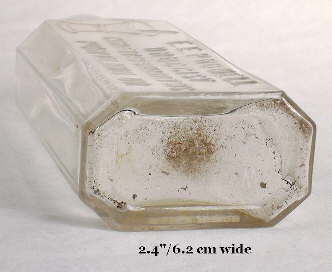 The
bottle pictured to the left is a "tall" Blake style with
relatively wide beveled corners which was made by the
Whitall Tatum Company (Millville, NJ) who offered several different
types and many sizes of Blake type prescription bottles (Whitall Tatum
1880, 1892, 1909). The picture to the right shows the base profile
and relatively wide beveled corners.
The bottle is embossed
vertically (in a plate) with E. E. PROWELL / DRUGGIST / COR. FIRST &
MARKET STS. / PORTLAND, OR. In addition there is an embossed
druggist mortar & pestle on the upper part of the plate and W. T. &
CO. / G on the base. It was mouth-blown with a tooled
prescription finish, blown in a cup-bottom mold, and has four air venting
marks on the edges of the base only, none on the body (unusual
orientation). According to the early Portland business directories, E.
E. Prowell was in business at this address in only 1888 and 1889
(pers. research).
Click on the following links to view more images of this bottle:
base view;
side view. According to Mike Miller's excellent book
on Arizona bottles, E. E. Prowell left Portland in early 1890 and moved to
Phoenix, AZ. (driven out by the wet winters?) where he operated the Opera
House Drug Store (it was located in the Patten Opera House Building) from
1890 to 1891 before selling out in October 1891. He also had a very
similar embossed bottle made for his Phoenix drugstore by Whitall Tatum
which included the mortar & pestle in the same location (Miller 1999).
Apparently, Prowell could only stand the druggist business for a couple
years at a time! The
bottle pictured to the left is a "tall" Blake style with
relatively wide beveled corners which was made by the
Whitall Tatum Company (Millville, NJ) who offered several different
types and many sizes of Blake type prescription bottles (Whitall Tatum
1880, 1892, 1909). The picture to the right shows the base profile
and relatively wide beveled corners.
The bottle is embossed
vertically (in a plate) with E. E. PROWELL / DRUGGIST / COR. FIRST &
MARKET STS. / PORTLAND, OR. In addition there is an embossed
druggist mortar & pestle on the upper part of the plate and W. T. &
CO. / G on the base. It was mouth-blown with a tooled
prescription finish, blown in a cup-bottom mold, and has four air venting
marks on the edges of the base only, none on the body (unusual
orientation). According to the early Portland business directories, E.
E. Prowell was in business at this address in only 1888 and 1889
(pers. research).
Click on the following links to view more images of this bottle:
base view;
side view. According to Mike Miller's excellent book
on Arizona bottles, E. E. Prowell left Portland in early 1890 and moved to
Phoenix, AZ. (driven out by the wet winters?) where he operated the Opera
House Drug Store (it was located in the Patten Opera House Building) from
1890 to 1891 before selling out in October 1891. He also had a very
similar embossed bottle made for his Phoenix drugstore by Whitall Tatum
which included the mortar & pestle in the same location (Miller 1999).
Apparently, Prowell could only stand the druggist business for a couple
years at a time!
Additional images/information on
rectangular druggist bottles:
-
 S. G. SKIDMORE & CO. - This standard Blake style druggist bottle has
flattened beveled corners of a more typical width than the Prowell
bottle above. It is embossed vertically
in a plate with S. G. SKIDMORE & CO. / DRUGGISTS / 151 FIRST ST. /
PORTLAND, OREGON. A check of the diagnostic features indicates an 1880s
production as the bottle lacks obvious evidence of mold air venting
though it does have a typical tooled prescription finish and was blown
in a cup-bottom mold. Business directory research indicate that this
druggist did business under this name from 1878 to 1905; this bottle
would be from the early end of that range based on the diagnostic
features (Anonymous no date). It is possible that the air venting marks are
hidden in the embossing pattern, though that was not commonly done until the
early 20th century.
Click on the following links to view a couple more images of this
bottle:
base view showing the
W. T. & CO. makers marking (Whitall, Tatum &
Co.);
side view.
A bit of the history of this company was noted in the previous section
on square druggist bottles which indicates a lengthy business period
necessitating manufacturing related diagnostic features to narrow the
production date range. S. G. SKIDMORE & CO. - This standard Blake style druggist bottle has
flattened beveled corners of a more typical width than the Prowell
bottle above. It is embossed vertically
in a plate with S. G. SKIDMORE & CO. / DRUGGISTS / 151 FIRST ST. /
PORTLAND, OREGON. A check of the diagnostic features indicates an 1880s
production as the bottle lacks obvious evidence of mold air venting
though it does have a typical tooled prescription finish and was blown
in a cup-bottom mold. Business directory research indicate that this
druggist did business under this name from 1878 to 1905; this bottle
would be from the early end of that range based on the diagnostic
features (Anonymous no date). It is possible that the air venting marks are
hidden in the embossing pattern, though that was not commonly done until the
early 20th century.
Click on the following links to view a couple more images of this
bottle:
base view showing the
W. T. & CO. makers marking (Whitall, Tatum &
Co.);
side view.
A bit of the history of this company was noted in the previous section
on square druggist bottles which indicates a lengthy business period
necessitating manufacturing related diagnostic features to narrow the
production date range.
-
  SKIDMORE DRUG CO. - Yet another bottle
(immediate right) from this popular
Portland (OR) drugstore. It is embossed vertically in a
plate with PRESCRIPTION (in semi-circle above) / SKIDMORE DRUG CO. (in a
banner) / DRUGGISTS (in a semi-circle below) /
PORTLAND, ORE. It is also embossed on the base faintly with C. L.
G. CO. which indicates a manufacture by the Carr-Lowrey Glass Co.
(Baltimore, MD.) which was in business from 1889 to at least the 1970s,
though the mark was used from the 1889 founding to at least the early
1920s (Lockhart et al. 2014m). Besides the usual druggist bottle diagnostic
features this one also has at least one mold air venting mark on the
shoulder. This bottle likely dates from about 1900 to 1912 and has
the original label indicating it was used for "Oil of Eucalyptus."
Click on the following links for more images of this bottle:
base view (though the makers mark is not really visible);
view of
the original label. (Note: Later research indicates that
this drugstore did business under this particular name from 1906 to at
least 1915, fitting the date range above well.) SKIDMORE DRUG CO. - Yet another bottle
(immediate right) from this popular
Portland (OR) drugstore. It is embossed vertically in a
plate with PRESCRIPTION (in semi-circle above) / SKIDMORE DRUG CO. (in a
banner) / DRUGGISTS (in a semi-circle below) /
PORTLAND, ORE. It is also embossed on the base faintly with C. L.
G. CO. which indicates a manufacture by the Carr-Lowrey Glass Co.
(Baltimore, MD.) which was in business from 1889 to at least the 1970s,
though the mark was used from the 1889 founding to at least the early
1920s (Lockhart et al. 2014m). Besides the usual druggist bottle diagnostic
features this one also has at least one mold air venting mark on the
shoulder. This bottle likely dates from about 1900 to 1912 and has
the original label indicating it was used for "Oil of Eucalyptus."
Click on the following links for more images of this bottle:
base view (though the makers mark is not really visible);
view of
the original label. (Note: Later research indicates that
this drugstore did business under this particular name from 1906 to at
least 1915, fitting the date range above well.)
-
WM. D. BARRY "prescription" whiskey
bottle - Pictured to the above right (right bottle) is an example of a
"Blake" style rectangular prescription druggist bottle being clearly
used for whiskey. The bottle is labeled as such (click
label close-up to see such) and is also embossed as follows:
WM. D. BARRY / RELIABLE FAMILY LIQUOR STORE / 2024 FOURTEENTH STREET
N.W. / WASHINGTON, D.C. Mr. Barry operated the store at that
location from 1909 to 1914 when he moved to a different location down
the street. This bottle was found during the remodeling of a house
nearby that was built in 1911; the bottle likely left by "medicated"
workmen constructing the house. A one page PDF file detailing the
history is available at the following link:
Wm. D. Barry history summary. (Images and history courtesy of
Troy Hughes the current resident of the house the bottle was
discovered.)
-
 "Classic
Oblong" style drug/chemical bottle - This commonly encountered
bottle on mid-20th century historic sites is what the maker - the
Owen-Illinois Glass Co. - called in their catalogs a "Classic
Oblong" and listed in those catalogs "Drug & Chemical Containers"
sections (Lucas County Bottle Co. 1940s; Owens-Illinois Glass Co. 1952;
1962). This example is 5.5" tall, holds 4 oz., has an external
screw cap finish, and made of colorless glass that is slightly straw
colored indicating glass decolorization with arsenic and/or selenium.
Click
side view to see such which has several staggered vertical ribs
defining the edge of the side. Click
base view to see such which, although hard to read, is embossed with
DES. PAT. / 94824 along with a mold number "2" (to left side of base)
and the glass makers marking (the earlier "Saturn" marking) with an
undecipherable plant number, but a likely "38" date code (to right side
of base). The base also shows some of the suction scar made by the
Owens Automatic Bottle Machine. The best way to understand the
somewhat "Art Deco" design is to view the original
Design Patent #94824 which was issued in 1935 to an (apparent)
employee of the glass company. The patent date along with the
noted catalog information indicates this bottle was popular from 1935
until at least the early 1960s, this being an earlier example indicated
by the 1938 date code. (All of the later examples would also have
date codes on the base, if decipherable.) It is likely that these
bottles were also used for other products like hair tonic, aftershave,
and other toiletries. "Classic
Oblong" style drug/chemical bottle - This commonly encountered
bottle on mid-20th century historic sites is what the maker - the
Owen-Illinois Glass Co. - called in their catalogs a "Classic
Oblong" and listed in those catalogs "Drug & Chemical Containers"
sections (Lucas County Bottle Co. 1940s; Owens-Illinois Glass Co. 1952;
1962). This example is 5.5" tall, holds 4 oz., has an external
screw cap finish, and made of colorless glass that is slightly straw
colored indicating glass decolorization with arsenic and/or selenium.
Click
side view to see such which has several staggered vertical ribs
defining the edge of the side. Click
base view to see such which, although hard to read, is embossed with
DES. PAT. / 94824 along with a mold number "2" (to left side of base)
and the glass makers marking (the earlier "Saturn" marking) with an
undecipherable plant number, but a likely "38" date code (to right side
of base). The base also shows some of the suction scar made by the
Owens Automatic Bottle Machine. The best way to understand the
somewhat "Art Deco" design is to view the original
Design Patent #94824 which was issued in 1935 to an (apparent)
employee of the glass company. The patent date along with the
noted catalog information indicates this bottle was popular from 1935
until at least the early 1960s, this being an earlier example indicated
by the 1938 date code. (All of the later examples would also have
date codes on the base, if decipherable.) It is likely that these
bottles were also used for other products like hair tonic, aftershave,
and other toiletries.
-
More in the future...
Dating summary/notes: See
the
Druggist Bottle Dating Summary/Notes section just after the "Oval"
druggist bottles discussion below.
|
|
Oval
 Probably
the most popular "type" of druggist/prescription bottle styles were the "oval"
type bottles. These bottles vary in actual cross-section shape but
are always rounded on one or more sides and/or the corners. Beyond
that, the shapes vary widely with some being rounded or flattened on both the front and back
or even all sides, but with rounded corners as the binding feature if the
cross-section shape is somewhat rectangular. (The rectangular shape
discussed above has both flattened sides and corners.) The
most common oval style druggist bottles with a
flattened front panel (for a plate) with the sides and back being rounded
together with no obvious break between them (base pictured below) were known
by most bottle makers as the "Philadelphia Oval"; a style which is discussed more
below (pictured to the left). Probably
the most popular "type" of druggist/prescription bottle styles were the "oval"
type bottles. These bottles vary in actual cross-section shape but
are always rounded on one or more sides and/or the corners. Beyond
that, the shapes vary widely with some being rounded or flattened on both the front and back
or even all sides, but with rounded corners as the binding feature if the
cross-section shape is somewhat rectangular. (The rectangular shape
discussed above has both flattened sides and corners.) The
most common oval style druggist bottles with a
flattened front panel (for a plate) with the sides and back being rounded
together with no obvious break between them (base pictured below) were known
by most bottle makers as the "Philadelphia Oval"; a style which is discussed more
below (pictured to the left).
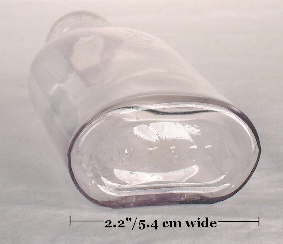 The
group of oval druggist bottles is particularly rich with subtle
variations some of which grade into the other discussed style shapes. Late 19th and early 20th century glass catalogs offered
scores of differently named proprietary variations on the "oval" theme which
seem to only have in common the fact that some side(s) or edge(s) were rounded.
A sampling of the proprietary named examples include the "Phenix", "Knickerbocker",
"Manhattan", "Seal", "Millville Rounds", and others in the 1902 Whitall
Tatum & Co. catalog (scan below); "Premier", "Golden Gate", "Ideal", "Sun",
"Favorite", and others in the 1903 Illinois Glass Glass Company
catalog; "Lyric", "Signet", "Wizard", "Crown", "Polish", and others in the
1920 Illinois Glass Company catalog; and "Aseptic", "Rex", "Dixie",
"Panama", "St. Louis", and others in the 1922 Obear-Nester Glass
Company catalog. Click on the small page illustration below for a scan from the Whitall Tatum & Co. 1902 catalog that shows 6
different "oval" druggist bottles several of which are essentially
rectangular in cross-section, though with rounded corners; others have a
distinctly rounded side(s) or backs. The
group of oval druggist bottles is particularly rich with subtle
variations some of which grade into the other discussed style shapes. Late 19th and early 20th century glass catalogs offered
scores of differently named proprietary variations on the "oval" theme which
seem to only have in common the fact that some side(s) or edge(s) were rounded.
A sampling of the proprietary named examples include the "Phenix", "Knickerbocker",
"Manhattan", "Seal", "Millville Rounds", and others in the 1902 Whitall
Tatum & Co. catalog (scan below); "Premier", "Golden Gate", "Ideal", "Sun",
"Favorite", and others in the 1903 Illinois Glass Glass Company
catalog; "Lyric", "Signet", "Wizard", "Crown", "Polish", and others in the
1920 Illinois Glass Company catalog; and "Aseptic", "Rex", "Dixie",
"Panama", "St. Louis", and others in the 1922 Obear-Nester Glass
Company catalog. Click on the small page illustration below for a scan from the Whitall Tatum & Co. 1902 catalog that shows 6
different "oval" druggist bottles several of which are essentially
rectangular in cross-section, though with rounded corners; others have a
distinctly rounded side(s) or backs.
 Most all companies that produced
druggist bottles also offered what was possibly the most common style of
druggist bottle made from at least 1876 through the 1910s - the already
noted "Philadelphia Oval." If any one shape is the "standard"
oval bottle it is this style which had a gently rounded back merging
smoothly into the more abruptly rounded sides with a flat front panel
which most often contained a plate slot for proprietary embossing plates
(see pictures above). This style seems to have originated in the mid
1870s right around the time of the 1876 Centennial Exposition in
Philadelphia which may be responsible for the name, though that has not
been confirmed. The style is listed in the 1876 Whitall Tatum & Co. catalog as the "New
Philadelphia Oval" possibly indicating a recent introduction, though
the "new" in the name could just be part of their style name to
presumably differentiate it from other makers versions (Whitall Tatum &
Co. 1876). Their 1879 catalog
also noted that this shape could be "carried conveniently in the
pocket" and had no "sharp corners which are apt to break and
collect deposits" (Whitall Tatum & Co. 1879). Most all companies that produced
druggist bottles also offered what was possibly the most common style of
druggist bottle made from at least 1876 through the 1910s - the already
noted "Philadelphia Oval." If any one shape is the "standard"
oval bottle it is this style which had a gently rounded back merging
smoothly into the more abruptly rounded sides with a flat front panel
which most often contained a plate slot for proprietary embossing plates
(see pictures above). This style seems to have originated in the mid
1870s right around the time of the 1876 Centennial Exposition in
Philadelphia which may be responsible for the name, though that has not
been confirmed. The style is listed in the 1876 Whitall Tatum & Co. catalog as the "New
Philadelphia Oval" possibly indicating a recent introduction, though
the "new" in the name could just be part of their style name to
presumably differentiate it from other makers versions (Whitall Tatum &
Co. 1876). Their 1879 catalog
also noted that this shape could be "carried conveniently in the
pocket" and had no "sharp corners which are apt to break and
collect deposits" (Whitall Tatum & Co. 1879).
The Philadelphia Oval type druggist
bottle pictured above was produced by the Whitall Tatum & Co.
(Millville, NJ) who was one of the biggest producers of druggist bottles
during the era between the late 1870s and the 1920s. It is embossed
vertically in a plate with HENRY KESSLER /
DRUGGIST / LINKVILLE, OREGON and was made in at least three sizes - 1,
3 and 8 ounces - all of which were different sized plates (empirical
observations). Linkville was the pre-1893 name for
Klamath Falls, Oregon giving an almost certain ending date for this bottle
(McArthur 1952).
It was likely produced during the late 1880s as evidenced by air venting marks on the shoulder
(two on each side) which is typical of a mid to
late 1880s to early 20th century mouth-blown druggist bottle. Business
directory information also indicates that Kessler was not likely in
business in 1886 nor 1894 (the two directories available to the author listing this very
small town at the time) further supporting a late 1880s manufacturing date.
An online search of Google Books did find a period reference to Henry
Kessler in the 1889 as a "Druggist, Bookseller and Stationer" - a
typical array of products and services of drugstores during that era
(Caspar 1889). This and the noted business directory information
pegs this bottle as being from around 1889 give or take a year or two -
about as close as bottle dating can be! Click on the following
links to view more pictures of this bottle:
base view showing the W. T. & CO. makers mark embossing for the
Whitall, Tatum & Co., the oval back and
flattened front (for the plate);
side view;
close-up of the shoulder, neck, and finish with the shoulder air
venting marks pointed out.
 The
Philadelphia Oval "pharmacist" bottle pictured to the right has is
identical in shape and size to the Linkville bottle above but is bit earlier
and most
likely produced by a competing company to Whitall Tatum. It
is embossed within a plate: BLUMAUER
& HEUBNER / PHARMACISTS / PORTLAND OREGON. There is no base
embossing outside of a meaningless mold number ("6"). The embossed
proprietors' names provides the opportunity to date the bottle via the
Portland business directories, a check of which found that these two individuals were in
partnership in 1878 and 1879 and were not listed together prior to or
after that time. This bottle has no air venting in evidence -
consistent with its established manufacturing date range - but otherwise
exhibits the same features as the Linkville bottle above, i.e., plate mold
Philadelphia Oval shape,
tooled prescription finish, essentially colorless glass, and production in
a cup-bottom mold. The
Philadelphia Oval "pharmacist" bottle pictured to the right has is
identical in shape and size to the Linkville bottle above but is bit earlier
and most
likely produced by a competing company to Whitall Tatum. It
is embossed within a plate: BLUMAUER
& HEUBNER / PHARMACISTS / PORTLAND OREGON. There is no base
embossing outside of a meaningless mold number ("6"). The embossed
proprietors' names provides the opportunity to date the bottle via the
Portland business directories, a check of which found that these two individuals were in
partnership in 1878 and 1879 and were not listed together prior to or
after that time. This bottle has no air venting in evidence -
consistent with its established manufacturing date range - but otherwise
exhibits the same features as the Linkville bottle above, i.e., plate mold
Philadelphia Oval shape,
tooled prescription finish, essentially colorless glass, and production in
a cup-bottom mold.
 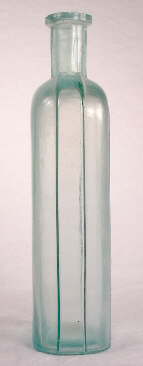 The
oval druggist/prescription bottle to the left is of the style known as the "union
oval prescription" by some glassmakers including the Whitall Tatum
Company that made this
specific
bottle (Whitall Tatum 1880; Illinois Glass 1906). Other makers
offered similar bottles called the "Baltimore Oval" with the flattened band
(aka "strap side") on the narrow sides (Illinois Glass 1903;
Obear-Nester 1922). The pictured bottle is embossed within a
plate with GOGINGS /
(monogram) / IRON / TONIC / 904 J. ST / SACRAMENTO.
The base is embossed with W. T. & CO. / PAT. NOV 17 80 giving an
earliest production date of essentially 1881, though the style could well
have been produced prior to patent. This bottle
has a tooled prescription finish, lacks
any evidence of mold air venting, and was blown in a cup-mold base. Click on
the following links to see more images of this bottle:
base view showing the W. T. & Co. and patent date embossing;
side view
showing the "strap side";
close-up of the
shoulder, neck, and prescription finish. The
oval druggist/prescription bottle to the left is of the style known as the "union
oval prescription" by some glassmakers including the Whitall Tatum
Company that made this
specific
bottle (Whitall Tatum 1880; Illinois Glass 1906). Other makers
offered similar bottles called the "Baltimore Oval" with the flattened band
(aka "strap side") on the narrow sides (Illinois Glass 1903;
Obear-Nester 1922). The pictured bottle is embossed within a
plate with GOGINGS /
(monogram) / IRON / TONIC / 904 J. ST / SACRAMENTO.
The base is embossed with W. T. & CO. / PAT. NOV 17 80 giving an
earliest production date of essentially 1881, though the style could well
have been produced prior to patent. This bottle
has a tooled prescription finish, lacks
any evidence of mold air venting, and was blown in a cup-mold base. Click on
the following links to see more images of this bottle:
base view showing the W. T. & Co. and patent date embossing;
side view
showing the "strap side";
close-up of the
shoulder, neck, and prescription finish.
Gogings Drug
Company was in business at this address from 1880 until well into
the 20th century. According to
an 1888 listing of their products, the "Gogings Iron Tonic" was trade marked in 1890
but was marketed at least as early as 1882 and possibly before that (Schulz &
Schulz 1990). Given the history and the diagnostic characteristics,
this bottle likely dates around 1882-1886. It is also an example of a proprietary or "patent"
medicine being produced and bottled by a local pharmacist using a typical
plate mold druggist type bottle, though in a somewhat unusual color (aqua)
as most bottles of this style are colorless. Use of a druggist type
bottle for a locally distributed patent/proprietary medicine was a relatively
frequent occurrence during the
heyday of these type bottles, i.e., 1880s to 1910s.
Aqua or "green" glass was likely ordered since it denotes "patent medicine" whereas colorless
glass implies "prescription product." This iron tonic undoubtedly had
a very limited geographical distribution as these bottles are uncommon even in Northern California. (Incidentally, there was
also a "union oval" type liquor flask that has some similarities to this
style druggist bottle. The main differences are that the liquor bottle almost always has a
different style finish (double ring is most common) and the body sides
taper in towards the base, not parallel like the druggist style union oval. See the
Bottle Typing/Diagnostic Shapes: Liquor/Spirits Bottles for more
information.)
 Machine-made
"oval" druggist bottles were also very commonly made and used from the beginning of
the machine era for narrow necked bottles (early to mid 1910s) through the
mid-20th century. The bottles pictured to the left are cork
closure finish
"oval" type (according to the glass catalogs) prescription bottles that were made in the 1920s (right) to
early 1930s (left) time period. Both have embossed capacity graduation markings as well as
the volume marking at the base of the neck, i.e., a stylized "3iii" on the
larger bottle for three fluid ounces and
a "1" in a circle on the smaller bottle for one ounce.
Both also have rounded backs typical of oval type prescriptions. Machine-made
"oval" druggist bottles were also very commonly made and used from the beginning of
the machine era for narrow necked bottles (early to mid 1910s) through the
mid-20th century. The bottles pictured to the left are cork
closure finish
"oval" type (according to the glass catalogs) prescription bottles that were made in the 1920s (right) to
early 1930s (left) time period. Both have embossed capacity graduation markings as well as
the volume marking at the base of the neck, i.e., a stylized "3iii" on the
larger bottle for three fluid ounces and
a "1" in a circle on the smaller bottle for one ounce.
Both also have rounded backs typical of oval type prescriptions.
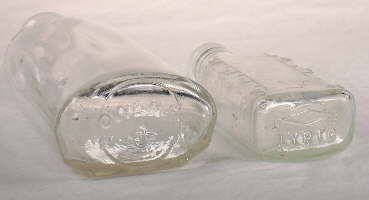 The larger bottle is embossed with
OWENS on the base along the
typical Owens-Illinois Glass Company makers markings indicating a
manufacture at the Evansville, IN. plant #11, which closed in 1930 (Lockhart
& Hoenig 2018u). This information dates the bottle tightly as made in
1929 or 1930. As the base picture
to the right
shows, the bottle also has an obvious suction scar indicating manufacture
on the Owens Automatic Bottle Machine. It also has the other usual
machine-made characteristics as covered on the
"Machine-made
bottles dating" page. The smaller bottle is embossed with
LYRIC on the base which was a
proprietary name for the Illinois Glass Company's patented "graduated
oval." The base also has the "I in a flattened diamond" marking for
that company and a distinct suction scar. The larger bottle is embossed with
OWENS on the base along the
typical Owens-Illinois Glass Company makers markings indicating a
manufacture at the Evansville, IN. plant #11, which closed in 1930 (Lockhart
& Hoenig 2018u). This information dates the bottle tightly as made in
1929 or 1930. As the base picture
to the right
shows, the bottle also has an obvious suction scar indicating manufacture
on the Owens Automatic Bottle Machine. It also has the other usual
machine-made characteristics as covered on the
"Machine-made
bottles dating" page. The smaller bottle is embossed with
LYRIC on the base which was a
proprietary name for the Illinois Glass Company's patented "graduated
oval." The base also has the "I in a flattened diamond" marking for
that company and a distinct suction scar.
The Lyric style was
made beginning about 1915 through the 1920s and possibly into the early
1930s. The larger bottle is very similar in overall style, but is
not embossed with "Lyric." (It may be what Owens-Illinois
called the "Signet Oval"; see the mid-1930s catalog from that company at
this link (page PP 18):
https://sha.org/bottle/Typing/OI1933/OI1933c.pdf.
) The Lyric style was illustrated as the first bottle in
the Illinois Glass Company's 1920 catalog and available (at that time) with only a cork finish
(Illinois Glass 1920; Whitten 2019). Click
1920
Illinois Glass Catalog page 15 to view this illustration. Click
side view
to see a side view image of both bottles. These styles of of oval druggist bottles were produced with external continuous
screw thread finishes beginning no later than 1927 (Owens Bottle Company
1927,1928) although cork finishes were obviously still available into at
least the mid 1930s. (To see David Whitten's write-up on the Lyric
style druggist bottle click on the following link:
http://www.glassbottlemarks.com/antique-lyric-brand-glass-prescription-bottles/
)
Additional images/information on
oval type druggist bottles:
-
 J. A. LOGAN - This druggist bottle is embossed (vertically in a
plate like most druggist bottles) with J. A. LOGAN / PRESCRIPTION
DRUGGIST / EAST PORTLAND, OR. It also has a figure of a mortar
and pestle which was a very common addition to the embossing of druggist
bottles for obvious reasons. The base is embossed with
W. T. CO. and a meaningless mold letter ("B").
This bottle is a style
called the "Baltimore Oval" by the Whitall, Tatum & Co.
and available at least as early as 1892 catalog (but not as early as
1880) and as late as at least 1909 (but not as late as 1924) based on
the company catalogs that the author has to consult (Whitall Tatum & Co.
1880,1892,1909,1924). The bottle has the usual druggist bottle
manufacturing characteristics of the era - cup-bottom mold configuration,
tooled prescription finish, with two air venting marks on the front and
back shoulders. Some other possible date refining evidence exists
in the fact that East Portland was a separate city between 1870 and 1891
when it was annexed into Portland proper. The clincher is that a
search of the Portland Business Directories indicates that J. A. Logan
was listed from 1885 to 1897 with no listings after that date giving a
pretty firm date range for this bottle of 1885 to 1891.
This business date range is consistent with the presence of air venting
and the East Portland location and gives us a firm manufacturing date
range. If additional 1880s Whitall, Tatum & Co.
catalogs were available some additional dating refinement could be
possible based on the introduction of this style. Click on the following links for more images of
this bottle:
base view showing the makers mark (faintly) and the slightly banded
sides;
side view. J. A. LOGAN - This druggist bottle is embossed (vertically in a
plate like most druggist bottles) with J. A. LOGAN / PRESCRIPTION
DRUGGIST / EAST PORTLAND, OR. It also has a figure of a mortar
and pestle which was a very common addition to the embossing of druggist
bottles for obvious reasons. The base is embossed with
W. T. CO. and a meaningless mold letter ("B").
This bottle is a style
called the "Baltimore Oval" by the Whitall, Tatum & Co.
and available at least as early as 1892 catalog (but not as early as
1880) and as late as at least 1909 (but not as late as 1924) based on
the company catalogs that the author has to consult (Whitall Tatum & Co.
1880,1892,1909,1924). The bottle has the usual druggist bottle
manufacturing characteristics of the era - cup-bottom mold configuration,
tooled prescription finish, with two air venting marks on the front and
back shoulders. Some other possible date refining evidence exists
in the fact that East Portland was a separate city between 1870 and 1891
when it was annexed into Portland proper. The clincher is that a
search of the Portland Business Directories indicates that J. A. Logan
was listed from 1885 to 1897 with no listings after that date giving a
pretty firm date range for this bottle of 1885 to 1891.
This business date range is consistent with the presence of air venting
and the East Portland location and gives us a firm manufacturing date
range. If additional 1880s Whitall, Tatum & Co.
catalogs were available some additional dating refinement could be
possible based on the introduction of this style. Click on the following links for more images of
this bottle:
base view showing the makers mark (faintly) and the slightly banded
sides;
side view.
-
  BLACKMAN & GOOD - A
somewhat frequently seen oval shape primarily from
the late 1880s through most or all of the 1890s had three flattened sides (none of which
are parallel to each other) and a long rounded back. This unusual
four-sided cross-section shape is easier to visualize than
explain; see the base view to the right. This particular bottle is
embossed (vertically within a plate) with BLACKMAN & GOOD / DRUGGISTS
/ COR. 4TH & MORRISON STS. / PORTLAND, OR. with the base embossed
M / PAT'D. MAY 15,88 / D. F. & CO. It has the usual
diagnostic features including air venting marks on the shoulders - one
on the front above the plate and three on the back. A check of the
Portland Business Directories indicates that these two individuals
(George L. Blackman and F. Louis Good) were in business together from
1892 to 1894, with Blackman continuing on alone after that time
(Anonymous no date; pers. research).
This allows for a very tight dating range. Most of these shaped
bottles have the noted embossing on the base which was for Dean,
Foster & Co., a "glass merchant" and possible bottle maker though
this is unclear. In any event, the D. F. & CO. base marking
marking is not uncommon on druggist bottles and this shape in particular (Toulouse 1971; Bethman 1991; Preble 2002; empirical observations). Click
side view to see such of this bottle. BLACKMAN & GOOD - A
somewhat frequently seen oval shape primarily from
the late 1880s through most or all of the 1890s had three flattened sides (none of which
are parallel to each other) and a long rounded back. This unusual
four-sided cross-section shape is easier to visualize than
explain; see the base view to the right. This particular bottle is
embossed (vertically within a plate) with BLACKMAN & GOOD / DRUGGISTS
/ COR. 4TH & MORRISON STS. / PORTLAND, OR. with the base embossed
M / PAT'D. MAY 15,88 / D. F. & CO. It has the usual
diagnostic features including air venting marks on the shoulders - one
on the front above the plate and three on the back. A check of the
Portland Business Directories indicates that these two individuals
(George L. Blackman and F. Louis Good) were in business together from
1892 to 1894, with Blackman continuing on alone after that time
(Anonymous no date; pers. research).
This allows for a very tight dating range. Most of these shaped
bottles have the noted embossing on the base which was for Dean,
Foster & Co., a "glass merchant" and possible bottle maker though
this is unclear. In any event, the D. F. & CO. base marking
marking is not uncommon on druggist bottles and this shape in particular (Toulouse 1971; Bethman 1991; Preble 2002; empirical observations). Click
side view to see such of this bottle.
-
 GRACE & BODINSON - This early 20th century druggist bottle has
the original label indicating that the prescription was filled in May of
1915 allowing for a fairly certain production date of 1913-1915 given
that a druggist could have had bottle on hand for a year or two prior
to use. It is embossed vertically in a plate with GRACE &
BODINSON / DRUG CO. / BAKER, OREGON and also has the volume and
graduation markings typical of an early 20th century mouth-blown
druggist bottle. It has a tooled "double collared ring" finish,
was blown in a cup-bottom mold, and has numerous air venting marks.
It is also embossed on the base with BLUE RIBBON indicating a
likely manufacture by the Standard Glass Company of Marion, IN.
which was in business from 1906 to 1932 (Toulouse 1971; Bethman 1991).
Druggist bottles with BLUE
RIBBON on the base may be either mouth-blown with a tooled finish (like
the pictured example) or machine-made, with the latter examples never having
proprietary embossing. Click on the following links to view more images of this bottle:
base view showing the BLUE RIBBON embossing;
reverse view
showing the original label and prescription date. Incidentally,
the three part "double collared ring" finish is most often observed on
druggist bottles with the BLUE RIBBON base embossing and
apparently a design more or less unique to the Standard Glass Co. (Preble 2002; empirical observations). GRACE & BODINSON - This early 20th century druggist bottle has
the original label indicating that the prescription was filled in May of
1915 allowing for a fairly certain production date of 1913-1915 given
that a druggist could have had bottle on hand for a year or two prior
to use. It is embossed vertically in a plate with GRACE &
BODINSON / DRUG CO. / BAKER, OREGON and also has the volume and
graduation markings typical of an early 20th century mouth-blown
druggist bottle. It has a tooled "double collared ring" finish,
was blown in a cup-bottom mold, and has numerous air venting marks.
It is also embossed on the base with BLUE RIBBON indicating a
likely manufacture by the Standard Glass Company of Marion, IN.
which was in business from 1906 to 1932 (Toulouse 1971; Bethman 1991).
Druggist bottles with BLUE
RIBBON on the base may be either mouth-blown with a tooled finish (like
the pictured example) or machine-made, with the latter examples never having
proprietary embossing. Click on the following links to view more images of this bottle:
base view showing the BLUE RIBBON embossing;
reverse view
showing the original label and prescription date. Incidentally,
the three part "double collared ring" finish is most often observed on
druggist bottles with the BLUE RIBBON base embossing and
apparently a design more or less unique to the Standard Glass Co. (Preble 2002; empirical observations).
-
More in the future...
Dating summary/notes: See
the
Druggist Bottle Dating Summary/Notes section below. |
Druggist Bottle Dating
Summary/Notes
The relatively precise dating of
mouth-blown druggist/prescription bottles* must be done, like with other
bottle types, using a mixture of manufacturing
based diagnostic features (see the
Bottle Dating pages for more dating information) in hand with
information from the historical record, when company/product related embossing
(aka
proprietary embossing) or
labeling allows such. Fortunately, proprietary embossing is
quite common within this class of bottles (like most of the druggist bottles
illustrated above) since it was inexpensive to have a mold plate engraved.
For example, the Whitall Tatum & Co. 1880 catalog noted a price of
"one dollar and fifty cents to six dollars each for engravings." As
noted elsewhere on this website, it is the embossed
or labeled bottles which provide the possibility of utilizing available
historical information to establish reliable dating ranges. If
abundant enough
information is available for a specific style of bottle (i.e., reliable manufacturing dates
for numerous examples of a style) the establishment of
a reasonable dating range for that style can often be derived. These
date ranges are also applicable to the
majority of bottles of the same style that do not have proprietary embossing.
Since a variety of different round, square,
rectangular, and oval druggist bottles were used for such a long period of
time, there are generally limited
dating opportunities available based on just the specific shape itself.
There are some trends however. One example noted above were the square druggist
bottles with beveled corners. It appears this style of mouth-blown
druggist bottle was a relatively popular shape with druggists primarily during the 1860s through the 1880s
and early 1890s.
(This same date range also seems to be somewhat true for round druggist bottles also.)
From the late 1870s on, the other three shapes (square, rectangular, and
oval) were much more popular with druggist. After about 1900, square
prescription bottle are somewhat unusual and often had rounded corners
instead of beveled (empirical observations). Like with all aspects
of bottle dating and
typology, there are always exceptions to be found though that does not
eliminate the utility of most dating and typology trends which should be
used in conjunction with the manufacturing related diagnostic features and
historical information as available.
The following are some general dating
trends for
typical druggist bottles. (Note: The mouth-blown portions of these
guidelines also pertain to the older style
citrate of magnesia bottles discussed later) :
-
Virtually all mouth-blown
paneled druggist/prescription bottles (the square, rectangular, oval
bottles discussed above) and most cylindrical ones were produced with
cup-bottom
molds. This is indicated by the absence of any mold seams
within
the confines of the bottle base. This observation includes druggist bottles produced as early as the
late
1850s (primarily square [image to the right] and round bottles) up until the almost total
disappearance of mouth-blown druggist bottles by the mid-1920s.
The common use of cup-bottom molds for most other types of bottles generally began in the mid-1880s to
even 1890s; druggist bottle
makers began using them much earlier. Early
druggist/pharmacy bottles like the pictured example with a very flat base
may have been produced in a mold without a base plate (i.e., the upper
mold halves sat on the floor of the glass works) or with a flat,
non-cupped base plate as they have no evidence of a heel mold seam and a
relatively sharp, almost non-existent heel (Kendrick 1968; empirical
observations). See
the
Bottle Type & Base Related Dating Notes
section of the Bottle Bases page.
-
Almost all prescription
bottles have
"standard" tooled finishes. Druggist bottles were some of
the earliest to be finished with the typically later
mouth-blown era method of finishing which results in the "tooled
finishes" as described on this website which was a more
technologically advanced method (for the time) that utilized a
finishing tool.
(This is discussed more in the
tooled finishes section
of the "Bottle Finishes & Closures" main page.) Why these
technological advances first appear commonly on druggist type (and
similarly shaped and sized proprietary medicinal) bottles is a
mystery though it may relate to the finish type ("prescription" finish)
commonly used on these bottles. It may also be that this
finishing technique worked better or easier on smaller and
lighter bottles - which most druggist bottles are - than with larger
heavier items like beer bottles which commonly had true applied finishes
into the early 1890s (Lockhart pers. comm. 2006). (Note: There is a
general trend towards any smaller
bottles - like druggist and small patent medicine bottles - being tooled earlier than larger
bottles. This observation is discussed on the
Bottle Finishes & Closures main webpage.)
-
 Given the above two points,
neither the diagnostic dating features pertaining to the base
conformation or type
(hinge mold vs. post-bottom mold vs. cup-bottom mold production) nor the applied vs. tooled
finishing methods assist much with the dating of druggist bottles. Given the above two points,
neither the diagnostic dating features pertaining to the base
conformation or type
(hinge mold vs. post-bottom mold vs. cup-bottom mold production) nor the applied vs. tooled
finishing methods assist much with the dating of druggist bottles.
- Mouth-blown (and often
proprietary embossed) druggist
bottles were made until at least the mid-1920's and likely some
continued to be produced even into the 1930s (Whitall Tatum 1924;
Toulouse 1971).
- Graduation markings (incremental
content amounts embossed on at least one side or edge) and the
druggist capacity mark (i.e., the stylized "3" shoulder embossing with Roman
numerals for ounces to the right of it) on a
druggist type bottle denotes an almost certain production after
1900. (Click on the picture to the right to view a larger image that has these features pointed out on a 1910-1920
era Oregon druggist bottle.) No bottle makers catalogs reviewed by the author have
listed bottles with this type of embossing prior to 1900. Some
druggist bottles from the 1890s will have the capacity in "CC's"
embossed on them, but do not have the stylized prescription capacity
and/or graduation marks (Whitall Tatum
1880,1892,1896; Illinois Glass 1899,1903).
Graduation and capacity markings were used until at least the mid-20th
century on glass druggist/prescription bottles (Knox Glass Co. ca. 1950;
Owens-Illinois Glass Co. 1952).
-
Mouth-blown druggist
bottles with the
collared ring finish style appear to be a product of the early 20th
century only, i.e., this finish type was only used on druggist type
bottles from maybe as early as 1900 to
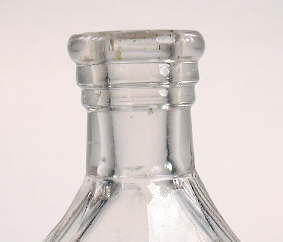 1905 to as late as 1925
(Whitall Tatum Co. 1892, 1902, 1924; Pollard 1993; Fletcher 1994;
Preble 2002). The picture to the right is of a three-part
"double" collared ring finish and is on a druggist bottle which almost
certainly dates from 1913 to no later than 1915. Most (all?) of these
finishes with three parts are found on bottles made by the
Standard Glass Company and usually have BLUE RIBBON on the base
(Preble 2002; empirical observations). 1905 to as late as 1925
(Whitall Tatum Co. 1892, 1902, 1924; Pollard 1993; Fletcher 1994;
Preble 2002). The picture to the right is of a three-part
"double" collared ring finish and is on a druggist bottle which almost
certainly dates from 1913 to no later than 1915. Most (all?) of these
finishes with three parts are found on bottles made by the
Standard Glass Company and usually have BLUE RIBBON on the base
(Preble 2002; empirical observations).
-
Later examples of all shapes of
druggist bottles
made by machines can have cork accepting prescription (or similar)
finishes and by the mid-1920s,
external continuous screw threads.
External screw threads seem to have first appeared on machine-made
druggist bottles during the early to mid-1920s though cork finishes lingered until
at least the early 1940s (Illinois Glass Co. 1920, 1926; Obear-Nester 1922; Whitall Tatum Co.
1924, 1937; Owens Bottle Co. 1927,1928; Owens Illinois Glass Co. 1940's,1952;
empirical observations). The following link -
Lyric Oval - shows one type of prescription bottle made by the
Illinois Glass Company by at least 1926 that was available with both a
threaded and cork finish (Illinois Glass Co. 1926). External screw threads are not found
on typical styles of mouth-blown druggist bottles with small necks.
-
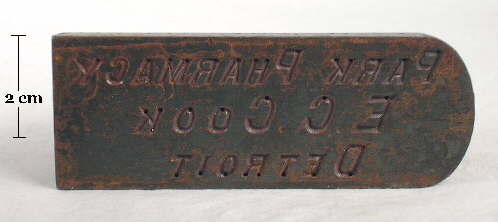 Air venting marks on mouth-blown
druggist bottles follow the
guidelines noted in that section of the
Bottle Body Characteristics & Mold Seams page. In
general, druggist bottles produced up to the mid to possibly late 1880s do
not have air venting marks and those after that time do have them in increasing
quantity as the mouth-blown era came to a close. Druggist bottles
with the air venting marks incorporated into the plate
related embossing almost surely date after 1900 and probably date
after
1905. The image here is of an original engraved plate, most likely
from the Whitall, Tatum & Co., for an
embossed druggist bottle that has the mold air venting holes evident upon
close inspection within the embossing grooves. The druggist
that had the pictured plate made was in business between about 1915 and 1918 (Mark
Hawkins pers. comm. 2006). Air venting marks on mouth-blown
druggist bottles follow the
guidelines noted in that section of the
Bottle Body Characteristics & Mold Seams page. In
general, druggist bottles produced up to the mid to possibly late 1880s do
not have air venting marks and those after that time do have them in increasing
quantity as the mouth-blown era came to a close. Druggist bottles
with the air venting marks incorporated into the plate
related embossing almost surely date after 1900 and probably date
after
1905. The image here is of an original engraved plate, most likely
from the Whitall, Tatum & Co., for an
embossed druggist bottle that has the mold air venting holes evident upon
close inspection within the embossing grooves. The druggist
that had the pictured plate made was in business between about 1915 and 1918 (Mark
Hawkins pers. comm. 2006).
There are, of course, exceptions to
the above guidelines like there is with every type or class of bottles.
However, the above points are thought to be quite reliable and useful for dating
druggist bottles that are either not embossed with druggist specific information
(e.g., name, address, city) or
for which no historical information is available if embossed with such.
(*Virtually
all proprietary embossed druggist/drugstore bottles are mouth-blown;
proprietary machine-made items are unusual though seen on rare
occasions. For example the bottle at the following links -
full
view,
base view - is a machine-made
"wide-mouth Blake" style druggist bottle with fairly
typical proprietary embossing, i.e. druggist name, mortar & pestle,
city/state (Portland, ME.). The base view shows the "diamond I" makers mark for
the Illinois Glass Company which dates the bottle definitively
between 1915 and 1929, with the most likely manufacturing time being
the 1920s [Toulouse 1971; Lockhart et al. 2005a].) |
|
"Shop Furniture"
(aka "Shelf Ware)
 "Shop
furniture" was the unusual (to the author at least) name for a relatively homogenous
group of larger bottles which were produced by many glassmakers for use by
druggists and drugstores as bulk containers to dispense bulk herbs, powders,
liquids, and many other chemical and medicinal products (pictured to the left).
Shop furniture bottles in glass appear to have been used by U. S.
apothecaries as early as the late 18th century (Griffenhagen & Bogard
1999). These large, indefinite
use bottles and jars were also called "shelf ware," "shelfware," "counter ware," "recess ware"
(bottles with the indented labels), and probably other names (Illinois
Glass Co. 1903,1911,1920; Bellaire Bottle Co. ca. 1905-1910; T. C. Wheaton Co. early 1920s; Whitall, Tatum &
Co. 1880,1909,1924; Griffenhagen & Bogard 1999). The "Tincture" illustration below is from the 1903
Illinois Glass Company (Alton, IL.) bottle catalog and shows a typical example of
a narrow necked
shop furniture bottle. Click on the illustration to view the entire page this illustration was taken
from showing other cylindrical examples. "Shop
furniture" was the unusual (to the author at least) name for a relatively homogenous
group of larger bottles which were produced by many glassmakers for use by
druggists and drugstores as bulk containers to dispense bulk herbs, powders,
liquids, and many other chemical and medicinal products (pictured to the left).
Shop furniture bottles in glass appear to have been used by U. S.
apothecaries as early as the late 18th century (Griffenhagen & Bogard
1999). These large, indefinite
use bottles and jars were also called "shelf ware," "shelfware," "counter ware," "recess ware"
(bottles with the indented labels), and probably other names (Illinois
Glass Co. 1903,1911,1920; Bellaire Bottle Co. ca. 1905-1910; T. C. Wheaton Co. early 1920s; Whitall, Tatum &
Co. 1880,1909,1924; Griffenhagen & Bogard 1999). The "Tincture" illustration below is from the 1903
Illinois Glass Company (Alton, IL.) bottle catalog and shows a typical example of
a narrow necked
shop furniture bottle. Click on the illustration to view the entire page this illustration was taken
from showing other cylindrical examples.
The following is quoted from
Munsey (1970) and is a nice overview of these bottles:
 Many of the more permanent glass
containers used by apothecaries...were ornately labeled by painting,
enameling, and so forth. An interesting and unusual method of labeling
pharmaceutical, barber, and bar bottles during the last half of the
nineteenth century was that of sealing labels on bottles under glass...On
bottles featuring recessed panels the labels are often covered with a
glass curved to fit the shape of the bottle. Many of the more permanent glass
containers used by apothecaries...were ornately labeled by painting,
enameling, and so forth. An interesting and unusual method of labeling
pharmaceutical, barber, and bar bottles during the last half of the
nineteenth century was that of sealing labels on bottles under glass...On
bottles featuring recessed panels the labels are often covered with a
glass curved to fit the shape of the bottle.
The labels for bottles used in a
drugstore are attractively made in gold foil and related materials and are
very durable. Because of their durability, and because they were
reused (and even passed on from father to son), many have survived and are
readily available...Almost without exception these reusable drug bottles
were made with matching glass stoppers that were ground to insure a near
perfect closure. The inside of the bottle neck was often ground, as
well, for the same reason.
Examples of the colorful labels used
on these type bottles during the early 20th century, as noted by Munsey, are found at the first two of the following links which are pages from the
1906
Illinois Glass Company's bottle catalog. These type labels are often
Latin (or Latinized) abbreviations making them hard to understand, like
the labels pictured above and at the following links. Also included in
these catalog page links are illustrations of the spectrum of druggist shop furniture
bottles and jars
offered by that company in 1906:
IGCo. 1906 pages 78-79;
IGCo. 1906 pages 80-81;
IGCo. 1906 pages 82-83;
IGCo. 1906 pages 84-85. As noted by Munsey, many of these type
bottles and jars had the labels placed in a recessed (indented) area of
the bottle with a thin covering of glass placed over the label. This
type of labeling first began in about 1862 when it was patented by William
Walton of Newark, N.J. (Griffenhagen & Bogard 1999). Click
William Walton September 23, 1862 to see the original patent.
The indentation and the glass label covering
greatly enhanced the longevity of the label and is referred to as a
"label-under-glass." Click on
label-under-glass jar for an image of a "salt-mouth" example with such
a label.
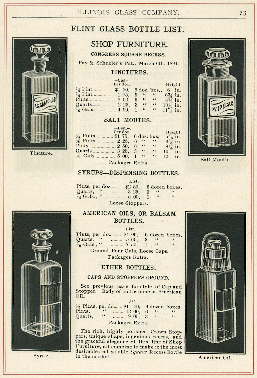 The three dark amber bottles or jars pictured above left have the makers
markings (T. C. W. CO. / U. S. A. on the base) indicating manufacture by
T. C. Wheaton & Co. (Millville, NJ). These bottles likely date
from the first couple decades of the 20th century and were still being
offered by the company in their 1920s era catalog as "Round Shoulder
Prescriptions" and specifically as "Saltmouths, Hollow Head Mushroom
Stoppered" in sizes from 1/2 oz to 32 oz.; the pictured bottles are about
24 oz. in size ( (T. C. Wheaton & Co. 1920s). These jars are typical of the
style which were usually closured with ground glass shank stoppers that
matched perfectly with the ground bore; click
bore view to see such. Most shop furniture bottles were made of colorless
glass although amber was also popular, most likely for its perceived light protective
qualities. Other glass colors are rare, but occasionally seen. "Salt-mouth" was a term
used by glassmakers for the wide bore (mouth) shop furniture - which were
usually used for the more solid materials, with the narrow
bore versions for liquids called "tincture" bottles. Both terms -
salt-mouth and tincture - in reference to shop furniture date back to the
18th century England (Whitall Tatum & Co. 1924; Griffenhagen & Bogard
1999). The three dark amber bottles or jars pictured above left have the makers
markings (T. C. W. CO. / U. S. A. on the base) indicating manufacture by
T. C. Wheaton & Co. (Millville, NJ). These bottles likely date
from the first couple decades of the 20th century and were still being
offered by the company in their 1920s era catalog as "Round Shoulder
Prescriptions" and specifically as "Saltmouths, Hollow Head Mushroom
Stoppered" in sizes from 1/2 oz to 32 oz.; the pictured bottles are about
24 oz. in size ( (T. C. Wheaton & Co. 1920s). These jars are typical of the
style which were usually closured with ground glass shank stoppers that
matched perfectly with the ground bore; click
bore view to see such. Most shop furniture bottles were made of colorless
glass although amber was also popular, most likely for its perceived light protective
qualities. Other glass colors are rare, but occasionally seen. "Salt-mouth" was a term
used by glassmakers for the wide bore (mouth) shop furniture - which were
usually used for the more solid materials, with the narrow
bore versions for liquids called "tincture" bottles. Both terms -
salt-mouth and tincture - in reference to shop furniture date back to the
18th century England (Whitall Tatum & Co. 1924; Griffenhagen & Bogard
1999).
The last two images are from two
different early 20th century glassmakers catalogs and show the typical
wares of the day (click each to view a higher quality version). As
shown, the shape of these bottles tend towards the same relatively uniform
round and square shapes, regardless of the manufacturer. The page to
the left is from the 1903 Illinois Glass Co.
catalog and shows some of the the square shop furniture items they offered. This
company offered shop furniture in their 1920 catalog also and have them
listed outside of the "machine-made bottles" section implying that they
were still being mouth-blown at least into the early 1920s (Illinois Glass
Co. 1920).
 The illustration to the right is
from the 1924 Whitall, Tatum & Co. catalog and shows the wares they
offered in the mid-1920s, which were almost certainly still being
mouth-blown at that time as were many of their smaller plate mold druggist
bottles. Similar large stoppered items like these (e.g., "Tinctures"
and "Saltmouths") were still being offered by the company as late as 1937
though it is unknown whether they were still being mouth-blown or were
machine-made; there is some indications that they were
mouth-blown at least in part (empirical observations). The illustration to the right is
from the 1924 Whitall, Tatum & Co. catalog and shows the wares they
offered in the mid-1920s, which were almost certainly still being
mouth-blown at that time as were many of their smaller plate mold druggist
bottles. Similar large stoppered items like these (e.g., "Tinctures"
and "Saltmouths") were still being offered by the company as late as 1937
though it is unknown whether they were still being mouth-blown or were
machine-made; there is some indications that they were
mouth-blown at least in part (empirical observations).
Dating summary/notes: Shop furniture
bottles/jars were produced in a similar fashion for a very extended period
in the U. S.; probably from at least the 1840s into at
least the 1940s. There is evidence that shop furniture bottles were
being used as early as 1770s in the U. S. though these bottles would have
been imported from Europe; such bottles commonly imported into at least
the 1850s (Griffenhagen & Bogard 1999).
Shop furniture bottles made from the 1870s to at least the mid-1920s
usually share the similarity of having been mouth-blown in a cup-bottom mold with
tooled finishes (these are rarely seen with applied finishes).
Earlier examples (pre-1870) tend to have pontil scars, though reflecting their
"specialty" nature, they were apparently produced with
pontil scars up until at least the late 19th century. Mouth-blown
examples were
made in both typical two-piece molds (where the side seams are visible) and
in paste or
turn-molds
(round bottles only) where the side seams were wiped out by the
rotation of the bottle in the mold (Bellaire Bottle Company ca. 1905-1910).
Click on the following links to view a turn-mold example from the last
half of the 19th century that is pontil scarred (photos courtesy of Jeff
Browning):
base view showing the glass tipped pontil scar;
view of the entire bottle;
close-up showing the distinct concentric rings on the lower body
indicative of turn-mold manufacture. Due
to their specialized nature and relatively low volume production (they were used for years and not discarded
unless broken) shop furniture was
apparently made by mouth-blown methods much later than most other bottle styles
(Whitall Tatum & Co. 1924, 1937). As noted above, shop furniture
bottles with indented panels and under glass labels first appeared about
1862.
Machine-made examples probably first became
somewhat available with the advent of fully automatic bottle machines in the 1910s,
but the style appears not to have been dominated by machines until at least the late
1920s (Illinois Glass Co. 1920, 1926; Whitall Tatum 1924). This is consistent with the fact that machines
were expensive to set up and were cost effective only for large runs of
bottles, not short runs of specialty items like shop furniture (Miller &
McNichol 2002). Shop furniture was produced to some degree until at least
the mid-20th century (Lucas County Bottle Co. 1940s). By that
time the rise of the large
national pharmaceutical firms and chain drugstores (e.g., Rexall) producing
and selling standardized, pre-formulated and packaged medicines drove the
local druggist - who had for many decades produced their own medicinal
preparations - to virtual extinction (Preble 2002). With them went
the remaining need and demand for shop furniture.
Since these bottles were used until broken they are
uncommonly found on most historic sites though are quite
commonly seen in antique stores, on eBay®,
and similar places as they were rarely thrown away even after their use
ceased with the disappearance of the traditional "corner drugstore."
Shop furniture bottles and jars are still occasionally seen as purely
decorative items behind the druggist counters in chain drugstores large and
small. (Note: Without a doubt, the best discussion on shop
furniture - with copious illustrations - is found in Griffenhagen & Bogard
(1999), pages 51-70. The discussion on this page only scratches the
surface of the subject.) |
|
Homeopathic
Vials/Bottles
  Homeopathic bottles,
primarily the vials the final
product was dispensed in for patient or consumer use, were a simple but
distinctively shaped
class of bottles. Based on the number of questions the author of
this site has received on these small bottles a brief overview of the subject needs discussed
on this page. These vials are very commonly found on historic
sites throughout the U. S. and Canada - and probably other places around
the world. But what is homeopathic medicine?
One source to quickly explain this alternative form of medicine is the
National Center for Homeopathy. The following was taken
from their website at this link -
http://nationalcenterforhomeopathy.org/: Homeopathic bottles,
primarily the vials the final
product was dispensed in for patient or consumer use, were a simple but
distinctively shaped
class of bottles. Based on the number of questions the author of
this site has received on these small bottles a brief overview of the subject needs discussed
on this page. These vials are very commonly found on historic
sites throughout the U. S. and Canada - and probably other places around
the world. But what is homeopathic medicine?
One source to quickly explain this alternative form of medicine is the
National Center for Homeopathy. The following was taken
from their website at this link -
http://nationalcenterforhomeopathy.org/:
Homeopathy is a system of medical therapy that uses very small doses
of medicines, or remedies. These remedies are prepared from substances
found in nature. Nevertheless, homeopathy should not be confused with
herbal medicine. These two systems of medicine are very different.
Herbal medicine uses tinctures of botanical substances, whereas
homeopaths use ultra-dilute "micro" doses made from not only plants, but
minerals or any other substance found in nature. The homeopathic doctor chooses the proper
remedy by following a special rule
of nature called the Law of Similars.
This law states "like cures like," or that a medicine can cure a sick
person if it can cause similar sickness in a healthy person. For
instance, if you peel an onion, your eyes burn, itch and water. You
might also have a runny nose and begin to sneeze. If you had similar
symptoms during a cold or allergy attack, such as a runny nose, watery
eyes and sneezing, a homeopathic micro-dose of the remedy
Allium cepa (red onion) would help your body heal itself. The word "homeopathic" is derived from the Greek
words homeos meaning "similar" and pathos meaning "disease" or
"suffering." Thus, homeopathy means "to treat with a remedy that
produces an effect similar to the disease or suffering."
The vial pictured
above (two views of the original label) is typical of this bottle type
almost exclusively used for homeopathic preparations. This
particular example is about 2.5" tall, 0.75" in diameter, and made of
colorless glass which has since turned slightly amethyst due to
manganese dioxide being used as a decolorizer and some exposure to
sunlight. It was certainly mouth-blown (given the label date) but has
no evidence of mold seams on the base, body or finish (more on this
below). This particular bottle came from an old drugstore
in Baker, Oregon (Levinger Drugstore) and has the original
label noting that it was produced or dispensed on February 27, 1911.
The label notes that it contained "3X. Gnaphalium". Gnaphalium
polycephalum is an Aster family herb which is used for a variety of
homeopathic treatments, though in particular, "intractable sciatica" - a
spinal problem. The "3X" is the dilution level, i.e., "triturated"
by a factor of 10 (the X=10) three times or, I believe, 1 part the
active ingredient to 1000 parts inert ingredients (Karen Allen C.C.H.,
pers. comm. 2012).
The homeopathic vial style typically came in many
sizes of "long" and "short" versions, the example
above being a "short" version. Although both styles came
in the same array of internal capacities, the "short" version (three on
right in the image below) were shorter with wider bodies and bores and the
"long" styles (one on left in image below) were taller but narrower with
narrower bores. The 1906
Illinois Glass Company catalog scanned and posted on this
website has a couple pages devoted to these vials in both varieties which
may be viewed at the following link:
1906 homeopathy vials.
The finish on these bottles - and the pictured
examples (with one exception below) - was
referred to as
patent finish by glassmakers (Whitall Tatum & Co. 1879, 1880;
Illinois Glass Co. 1906, 1920, 1926). The style dates back to at
least to the 1870s and at least as late as the 1930s. The vast
majority of these vials, in the authors experience, have no evidence of mold seams
indicating probable turn-molding (or possible later production in a
press-and-blow machine with a one piece blow mold?) from the 1870s into the 1920s
at least (Whitall, Tatum & Co. 1879; Owens-Illinois Glass Co. 1930; empirical
observations). Later machine-made ones have been noted with
regular vertical side seams probably dating from the 1920s to 1940s
(empirical observations).
 A
group of 4 smaller (~2.5" to ~3.5") homeopathy vials are also shown to the
right. The narrower example to the left in the image is a "long"
version of these vials; the other three are "short" examples as discussed
above. The glass used to produce these bottles was also decolorized
with manganese dioxide and exposed to UV light as indicated by the
lavender colors. Of interest in this discussion is that the shortest
vial (second from right) is a mouth-blown example that was not turn-molded
with a tooled "bead" finish. It is a bit different in shape (longer
neck) and could have been used as a pill vial not homeopathic
preparations. Without the original labeling one will never know for
sure, though the shape is similar to both the homeopathy and pill vials of
the era (1900 to 1920). The other three examples are typical
homeopathic vials with the "patent finish" and no mold seams in evidence. A
group of 4 smaller (~2.5" to ~3.5") homeopathy vials are also shown to the
right. The narrower example to the left in the image is a "long"
version of these vials; the other three are "short" examples as discussed
above. The glass used to produce these bottles was also decolorized
with manganese dioxide and exposed to UV light as indicated by the
lavender colors. Of interest in this discussion is that the shortest
vial (second from right) is a mouth-blown example that was not turn-molded
with a tooled "bead" finish. It is a bit different in shape (longer
neck) and could have been used as a pill vial not homeopathic
preparations. Without the original labeling one will never know for
sure, though the shape is similar to both the homeopathy and pill vials of
the era (1900 to 1920). The other three examples are typical
homeopathic vials with the "patent finish" and no mold seams in evidence.
The 1906
Illinois Glass Company catalog scanned and posted on this
website has a couple pages devoted to these vials with "patent finishes";
both pages may be viewed at the following link -
1906 homeopathy vials. By their 1920 catalog (also completely
scanned and posted on this site) the variety had increased a bit in
regards to the finishes available, i.e., they were available with the
standard "patent" type collar, ones with no distinctive finish (the
straight finish "shell vials"), and now with an
external screw thread finish and a metal screw cap closure.
Click on the following links to see the three pages devoted in this 1920
catalog to these vials:
1920 standard finish homeopathy vials - page 228;
1920 homeopathy "shell" vials - page 229;
1920 screw threaded homeopathy vials - page 230. The
1926 Illinois Glass Company catalog also listed the same styles
and finishes for these vials with the notation that they were "machine
made homeopathy vials." Click on the following links to see the
three pages devoted in the 1926 catalog to these vials:
1926 standard finish homeopathy vials - page 304;
1926 screw threaded homeopathy vials - page 305;
1926 homeopathy "shell" vials - page 306.
Finally, although not scanned and posted on this website, two early
Whitall, Tatum & Co. (NJ) catalogs offered identical homeopathic
vials to the above early 20th century examples, featuring
"heavy...patent tool finishes" and the straight finish "case vials"
(Whitall, Tatum & Co. 1879, 1880). All the noted catalogs (except
1926) listed the vials as available in amber and blue glass, although
production in true colored glass (not colorless which later turned a
mild amethyst tint) was
unusual.
 One other type of homeopathy bottle
much less encountered than the
vials are the bulk bottles which held the concentrated ingredient
used to produce the homeopathic preparation dispensed in the vials. The image to the
left is of two bulk
homeopathic bottles that are more or less like the "French square" style
discussed in the druggist bottle section above. These bottles are
embossed vertically on one side with BOERICKE & TAFEL'S /
TRITURATIONS.
In homeopathic medicine, "trituration" is "The
process of diluting a non-soluble substance for homeopathic use by
grinding it to a fine powder and mixing it with lactose powder" (Gale
Encyclopedia of Medicine 2008). One other type of homeopathy bottle
much less encountered than the
vials are the bulk bottles which held the concentrated ingredient
used to produce the homeopathic preparation dispensed in the vials. The image to the
left is of two bulk
homeopathic bottles that are more or less like the "French square" style
discussed in the druggist bottle section above. These bottles are
embossed vertically on one side with BOERICKE & TAFEL'S /
TRITURATIONS.
In homeopathic medicine, "trituration" is "The
process of diluting a non-soluble substance for homeopathic use by
grinding it to a fine powder and mixing it with lactose powder" (Gale
Encyclopedia of Medicine 2008).
Both bottles are about 7.5" tall, 2.8" per
side wide, and were blown in the same
post-bottom mold that shows no evidence of mold air venting. The
amber bottle has an applied "patent" finish though the aqua example has
a tooled finish. Given the difference in finishing methods,
different colors, and the noted mold based diagnostic features it is
clear that these bottles were blown during separate production runs (possibly years
apart)
during the transition time from applied to tooled finishes, i.e., late
1870s to mid-1880s. Click the following links to view more images
of these bottles:
base view showing the distinct post-bottom mold configuration having
a moderately domed "post" portion indenting the base;
close-up of the shoulder, neck and finishes with the side mold seam
termination point marked; and a view of just the
amber, applied finish example showing the embossing pattern more
clearly.
According to provider of these bottles:
Originally, these
bottles were used in the manufacturing facilities of Boericke & Tafel
homeopathic pharmacy in Santa Rosa, CA. This company was founded
1853 and had offices initially in Philadelphia, then expanded
across the country. Homeopathy was widely used in the western U.S. in the
1800s to early 1900s - many covered wagons carried their homeopathic
remedy kits with them as they came west. Boericke & Tafel was the
primary provider of homeopathic medicines for the west coast, and supplied
homeopathic hospitals in San Francisco. These bottles were not made for
the purpose of sales to the public. These are trituration bottles,
in aqua, yellow amber or dark amber glass, to hold the intermediate
substances as they go through the step by step process to create the final
medicine which was then bottled into small dispensing vials.
They were a thriving company until the
1930s-40s when the advent of antibiotics and other more powerful drugs
overshadowed and replaced much of homeopathy and other naturopathic forms
of medicine. When the company closed it's facilities in Santa Rosa
in the late 1940s, the bottles were given to a small private local museum
that featured historical items about medicine. Eventually, that
museum also closed and the bottles were donated to another museum...which
eventually de-accessioned these properties . These bottles were held
in storage for more than a decade, then divested as part of a large lot of
items.
Interesting, eh?! Click on this link -
Boericke & Tafel's
bottle group - to view an image of several
cases of these bulk bottles with the original labels and still
containing the white powdery bulk product used in the "triturations"
producing the final product.
These bottles all contain the concentrated homeopathic powder that is
white due to the lactose matrix. All the bottles have the same
closure - a lathed wood cap with a cork sheath which attached and glued to
a "peg" protruding from the base of the wooden cap.
NOTE: Bottles and history
provided courtesy of Karen Allen, C.C.H. -
www.karenallenhomeopathy.com Much thanks!
Dating summary/notes: Homeopathy vials -
a very homogenous category which really only vary in size and finish
type - do not following the dating rules laid out within this website very
well due to the bottles being made in a way that erased the mold seams
even though the later ones were likely machine-made. The dating of
the vials was covered in the body of the discussion above.
Conversely, the triturations bottles discussed above
follow quite well the guidelines presented throughout this website and
summarized on the
Bottle Dating page; see that page for more information.
|
|
Other
Shapes
There were other shapes used for
the packaging of the various products produced by druggists. These
may be expanded in the future as the opportunity allows; we are open to
ideas for additional druggist bottle types... |
|

 Medicinal
bottles are probably the largest and most diverse group of bottles produced
during the era covered by this website - the 19th through mid 20th centuries. To quote Fike
(1987) on medicine bottles - "Literally hundreds of thousands of brands
and variations of vessels were manufactured..." during the noted era.
This variety is not too surprising since one's health was (and still is) probably the
most important personal issue of all time, made even more important during
the era of
primitive medical knowledge and practices and universal ignorance about
hygiene and even the causes of disease. As noted in the opening line
of Odell (2000), "Medicine is as old as man, no doubt born of necessity
and wrought by trial and error." Self-medication was often
all that could be had by most people and the ability of doctors to help a
person - if they were even available - was very limited and their training
and/or
backgrounds often suspect. Thus, the allure of patent or proprietary
medicines (Young 1961).
Medicinal
bottles are probably the largest and most diverse group of bottles produced
during the era covered by this website - the 19th through mid 20th centuries. To quote Fike
(1987) on medicine bottles - "Literally hundreds of thousands of brands
and variations of vessels were manufactured..." during the noted era.
This variety is not too surprising since one's health was (and still is) probably the
most important personal issue of all time, made even more important during
the era of
primitive medical knowledge and practices and universal ignorance about
hygiene and even the causes of disease. As noted in the opening line
of Odell (2000), "Medicine is as old as man, no doubt born of necessity
and wrought by trial and error." Self-medication was often
all that could be had by most people and the ability of doctors to help a
person - if they were even available - was very limited and their training
and/or
backgrounds often suspect. Thus, the allure of patent or proprietary
medicines (Young 1961). The picture at the top of the page shows just
a tiny bit of medicinal bottle diversity which is frankly staggering in
depth and variety as virtually any shape imaginable was used at some
point. The bottle pictured to the left is a mid-19th century
medicine with a general shape (rectangular with indented panels) that was
used for tens of thousands of different medicinal products from the
mid-19th century until at least the Depression in the 20th century. Though intimidating in its immense diversity there are some useful trends in shapes that mark
a bottle as very likely to have been used primarily or originally as a
container for some type of medicinal product. The breadth of variety within the
medicinal bottle category is indicated by Fike (1987) dividing his classic
book (The Bottle Book: A Comprehensive Guide to Historic, Embossed
Medicine Bottles) into over 40 different "product" chapters, ranging
from "bitters" to "cures" to "purifiers" and many more. Within each
chapter is a listing of hundreds of different embossed bottles with
many times more embossed ones not addressed by Fike's book.
Add in the fact that most bottles were not embossed with product or
company names (probably less than 40% as late as 1890) and one can understand how
this website can not cover but a sampling of the medicinal bottles one
could find.
The picture at the top of the page shows just
a tiny bit of medicinal bottle diversity which is frankly staggering in
depth and variety as virtually any shape imaginable was used at some
point. The bottle pictured to the left is a mid-19th century
medicine with a general shape (rectangular with indented panels) that was
used for tens of thousands of different medicinal products from the
mid-19th century until at least the Depression in the 20th century. Though intimidating in its immense diversity there are some useful trends in shapes that mark
a bottle as very likely to have been used primarily or originally as a
container for some type of medicinal product. The breadth of variety within the
medicinal bottle category is indicated by Fike (1987) dividing his classic
book (The Bottle Book: A Comprehensive Guide to Historic, Embossed
Medicine Bottles) into over 40 different "product" chapters, ranging
from "bitters" to "cures" to "purifiers" and many more. Within each
chapter is a listing of hundreds of different embossed bottles with
many times more embossed ones not addressed by Fike's book.
Add in the fact that most bottles were not embossed with product or
company names (probably less than 40% as late as 1890) and one can understand how
this website can not cover but a sampling of the medicinal bottles one
could find. The
history of the patent and proprietary medicine industry is an exceptionally
interesting subject though beyond the scope of this website, which covers
primarily just the bottles - like the cabin shaped "bitters" bottle to the
left which dates from the 1860s or 1870s. If
interested, users are directed to consult some of the various publications noted
below or check some of the references mentioned throughout this page. However, a
few notable early 20th century historical events have some relevance to the dating and
typing of medicinal bottles, as follows:
The
history of the patent and proprietary medicine industry is an exceptionally
interesting subject though beyond the scope of this website, which covers
primarily just the bottles - like the cabin shaped "bitters" bottle to the
left which dates from the 1860s or 1870s. If
interested, users are directed to consult some of the various publications noted
below or check some of the references mentioned throughout this page. However, a
few notable early 20th century historical events have some relevance to the dating and
typing of medicinal bottles, as follows: The bottle pictured to the left is an example of some of the bottle
related adaptations patent medicine producers had to make after passage
of the above act in order to continue selling their product without
breaking the law. This bottle is embossed as follows:
DR. DEWITT'S LIVER BLOOD / & KIDNEY REMEDY / W. J. PARKER & CO. BALTO MD.
Upon close inspection one can see that word CURE was removed (a
more common version of this bottle has CURE) from the embossing
pattern via a small inserted plate which was instead engraved with
REMED on the plate itself with the letter Y just after it
engraved on the surface of the mold which was previously blank at the
point. Click
close-up of embossing to distinctly see the fine lined "box" made by
the edges of the plate which replaced CURE with REMED
along with the new letter Y.
The bottle pictured to the left is an example of some of the bottle
related adaptations patent medicine producers had to make after passage
of the above act in order to continue selling their product without
breaking the law. This bottle is embossed as follows:
DR. DEWITT'S LIVER BLOOD / & KIDNEY REMEDY / W. J. PARKER & CO. BALTO MD.
Upon close inspection one can see that word CURE was removed (a
more common version of this bottle has CURE) from the embossing
pattern via a small inserted plate which was instead engraved with
REMED on the plate itself with the letter Y just after it
engraved on the surface of the mold which was previously blank at the
point. Click
close-up of embossing to distinctly see the fine lined "box" made by
the edges of the plate which replaced CURE with REMED
along with the new letter Y.  This "Medicinal/Chemical/Druggist Bottles" page is divided somewhat
arbitrarily into the categories and subcategories listed below, with the
"Patent/Proprietary Medicinal Bottles" easily being the most diverse group
of shapes. Some bottle groupings naturally fall out as separate -
milk bottles, fruit jars, liquor flasks, Hutchinson sodas, and many
others. However, many of the most recognized and accepted categories
of medicinal bottles have been established primarily because someone wrote a definitive
book on that grouping. Though not all of these medicinal bottle
categories or types are addressed as separate categories on this page,
examples of this phenomena include Blasi's book on "balsam" bottles,
Watson and later Ring/Ham on "bitters" bottles, Jensen with "Owl Drug
Company" bottles, Agee on "cures", Nielsen and later Odell for
"pontiled medicines", Shimko and later DeGrafft for "sarsaparillas", and
others which are noted and referenced on this page (and for that matter,
throughout this website relative to other types of bottles). No
author has written a reference book on "Citrate of Magnesia" bottles, like
The Owl Drug Co. example pictured to the right, though there was at
least one book on that company's array of medicinal bottles (Jensen 1967).
This "Medicinal/Chemical/Druggist Bottles" page is divided somewhat
arbitrarily into the categories and subcategories listed below, with the
"Patent/Proprietary Medicinal Bottles" easily being the most diverse group
of shapes. Some bottle groupings naturally fall out as separate -
milk bottles, fruit jars, liquor flasks, Hutchinson sodas, and many
others. However, many of the most recognized and accepted categories
of medicinal bottles have been established primarily because someone wrote a definitive
book on that grouping. Though not all of these medicinal bottle
categories or types are addressed as separate categories on this page,
examples of this phenomena include Blasi's book on "balsam" bottles,
Watson and later Ring/Ham on "bitters" bottles, Jensen with "Owl Drug
Company" bottles, Agee on "cures", Nielsen and later Odell for
"pontiled medicines", Shimko and later DeGrafft for "sarsaparillas", and
others which are noted and referenced on this page (and for that matter,
throughout this website relative to other types of bottles). No
author has written a reference book on "Citrate of Magnesia" bottles, like
The Owl Drug Co. example pictured to the right, though there was at
least one book on that company's array of medicinal bottles (Jensen 1967).


 12-sided
pontiled scarred "tonic" bottle
12-sided
pontiled scarred "tonic" bottle


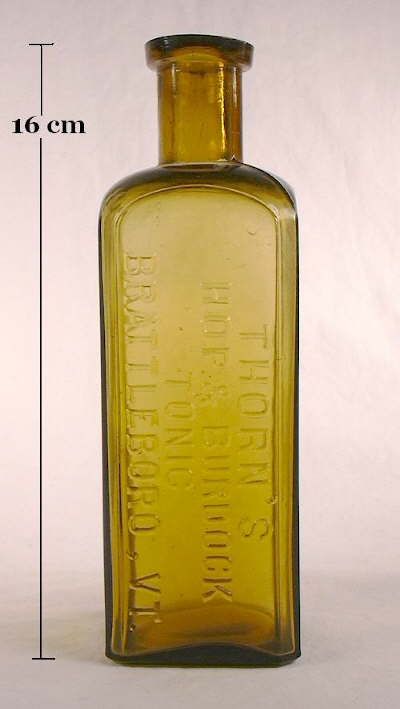


 DR.
GUYSOTT'S - YELLOW DOCK / & / SARSAPARILLA - B. & P. NEW YORK
DR.
GUYSOTT'S - YELLOW DOCK / & / SARSAPARILLA - B. & P. NEW YORK


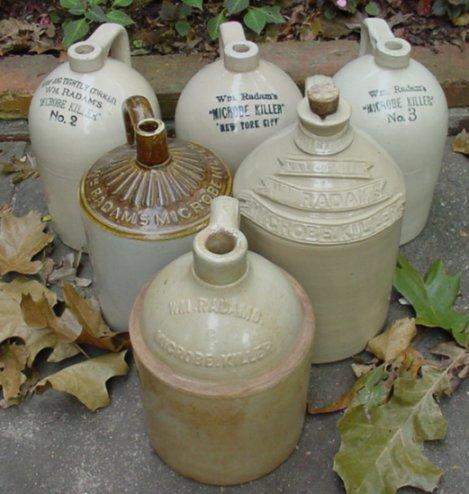




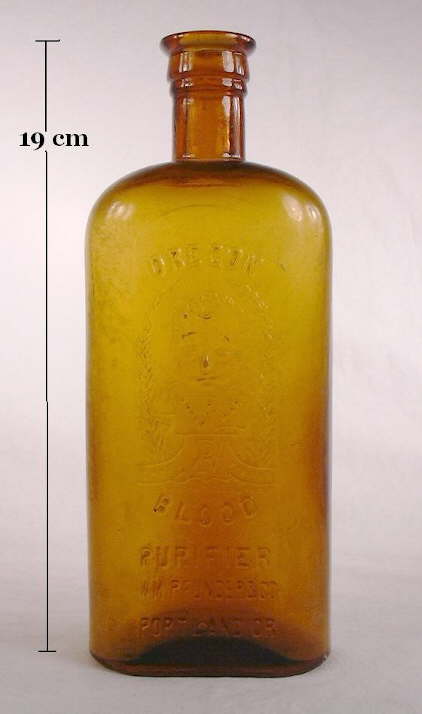


 Shoo-fly
liquor type flask used for Jamaica Ginger - (Image to the immediate
right.) Jamaica Ginger (product
discussed above) was frequently bottled in other shape medicine and even
liquor bottles like this small "shoo-fly" flask. The original
label reads "Pure Extract Jamaica Ginger Alcohol 95%, Guaranteed by
Kimball Bros. & Co. Under the Food and Drugs Act, June 30th, 1906, Serial Number
2310, Prepared By Kimball Bros & Co. Enosburg Falls, VT."
With it being 190 proof there couldn't have been much "ginger" in the product -
the alleged active medicinal ingredient. Also, that was a much higher percentage
of alcohol than the 80-100 proof whiskey that shoo-fly flasks were typically
used for. This little shoo-fly is mouth-blown, 5" tall,
colorless (aka "clear") glass, and has a tooled "brandy" finish like most such
flasks. The base is boldly embossed with an "O" in a flattened diamond. (Click
Shoo-fly
liquor type flask used for Jamaica Ginger - (Image to the immediate
right.) Jamaica Ginger (product
discussed above) was frequently bottled in other shape medicine and even
liquor bottles like this small "shoo-fly" flask. The original
label reads "Pure Extract Jamaica Ginger Alcohol 95%, Guaranteed by
Kimball Bros. & Co. Under the Food and Drugs Act, June 30th, 1906, Serial Number
2310, Prepared By Kimball Bros & Co. Enosburg Falls, VT."
With it being 190 proof there couldn't have been much "ginger" in the product -
the alleged active medicinal ingredient. Also, that was a much higher percentage
of alcohol than the 80-100 proof whiskey that shoo-fly flasks were typically
used for. This little shoo-fly is mouth-blown, 5" tall,
colorless (aka "clear") glass, and has a tooled "brandy" finish like most such
flasks. The base is boldly embossed with an "O" in a flattened diamond. (Click


 "Classic
Oblong" style drug/chemical bottle
"Classic
Oblong" style drug/chemical bottle


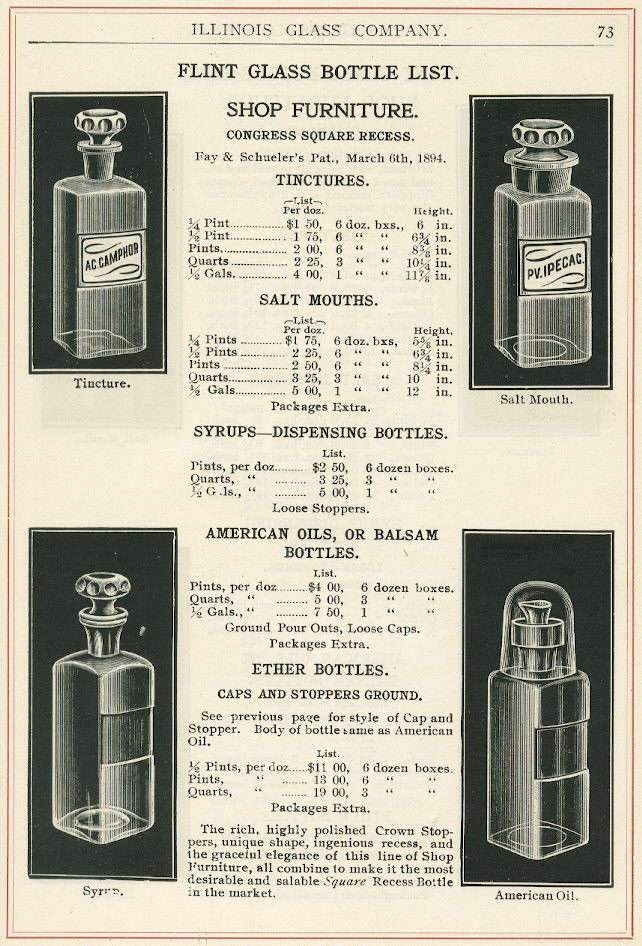

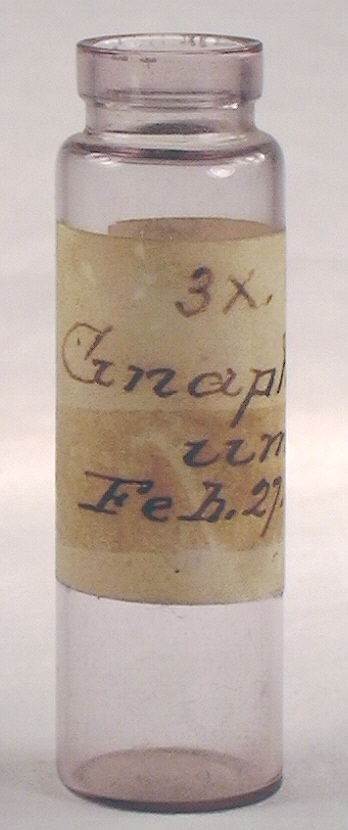


 Large
generic chemical/pharmaceutical bottles
Large
generic chemical/pharmaceutical bottles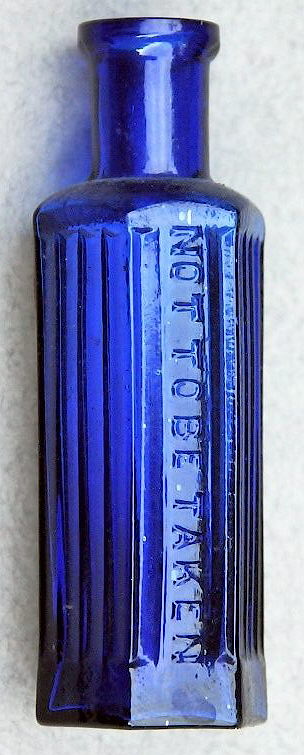
 Paregoric
Elixir "poison" bottle
Paregoric
Elixir "poison" bottle


 Beginning
in 1908,
Vaseline jars had external screw thread finishes - a close-up of
which is available at this link:
Beginning
in 1908,
Vaseline jars had external screw thread finishes - a close-up of
which is available at this link:


