
Household Bottles (non-food related)
HOME: Bottle Typing/Diagnostic Shapes: Household Bottles
Bottle Typing/Diagnostic Shapes
Household Bottles (non-food
related)
HOME:
Bottle Typing/Diagnostic Shapes:
Household Bottles
Click to move to the Organization & Structure Summary.
 This
non-food related Household bottles page is one of two typology pages (in
addition to the
Miscellaneous & Foreign bottles page) which comprise the "catch-all"
sections for bottle
types not otherwise covered by the other major bottle type
categories. Specifically, this page addresses non-food products clearly used in households across the United States
and Canada. These products were also used, of course, by businesses,
schools, government offices, and other non-household entities.
This
non-food related Household bottles page is one of two typology pages (in
addition to the
Miscellaneous & Foreign bottles page) which comprise the "catch-all"
sections for bottle
types not otherwise covered by the other major bottle type
categories. Specifically, this page addresses non-food products clearly used in households across the United States
and Canada. These products were also used, of course, by businesses,
schools, government offices, and other non-household entities.
 The
"household" (aka "personal") bottles category has been used by
archaeologists - and collectors to some degree - for many years although the
actual bottle types contained within the category varies significantly (Herskovitz
1978; Berge
1980; Univ. of Utah [IMACS] 1982; Felton et al. 1984; Jones & Sullivan 1989).
For example, canning/fruit jars which are included by some authors in the "household"
bottles category - or as an entirely separate category - are covered here on the
Food Bottles & Canning Jars page (Herskovitz 1978; Berge 1980). Another
example is that chemical and poison type bottles - which could have been covered
on this page or the "Miscellaneous bottles" page - are discussed on the
The
"household" (aka "personal") bottles category has been used by
archaeologists - and collectors to some degree - for many years although the
actual bottle types contained within the category varies significantly (Herskovitz
1978; Berge
1980; Univ. of Utah [IMACS] 1982; Felton et al. 1984; Jones & Sullivan 1989).
For example, canning/fruit jars which are included by some authors in the "household"
bottles category - or as an entirely separate category - are covered here on the
Food Bottles & Canning Jars page (Herskovitz 1978; Berge 1980). Another
example is that chemical and poison type bottles - which could have been covered
on this page or the "Miscellaneous bottles" page - are discussed on the
 Medicinal/Chemical/Druggist bottles
typology page which is consistent with what some other authors have also done (Herskovitz
1978; Univ. of Utah [IMACS] 1982).
Medicinal/Chemical/Druggist bottles
typology page which is consistent with what some other authors have also done (Herskovitz
1978; Univ. of Utah [IMACS] 1982).
In the end, there has never been total agreement on the categorization hierarchy of bottle types and probably never will be. The point behind these typology pages is not to establish a hierarchal classification system for bottle types but instead to help users identify what the most likely function or use was made of the specific bottle shape/type they are interested in determining such for. See the following "Organization & Structure" section for the specific bottle types that this website includes in the "household" category.
The other typology pages (e.g., "Liquor/Spirits bottles", "Food Bottles & Canning Jars", etc.) have larger introductory sections than this page or the "Miscellaneous & Foreign bottles" page. This is because the "household" and "miscellaneous" categories are much wider ranging in diversity and lacking the tighter or narrower "theme" of the other major categories. Instead, this page will have specific bottle type introductions incorporated into the opening paragraphs within each given section listed. Given this structural difference, the introduction for this page is considered complete; please scroll down to the "Organization & Structure" section below to begin.
NOTE: Attached to the "Bottle Types/Diagnostic Shapes" grouping of pages is a complete copy of a never re-printed, 280 page, 1906 Illinois Glass Company bottle catalog scanned at two pages per JPEG file. Click 1906 IGCo. Catalog to access the page that links to all the scans of this very useful catalog. Various household bottles are listed throughout this catalog including pages 36-43, 46-69, 74-77, 104-107, 278-287.
|
Bottle Typing/Diagnostic
Shapes:
Ink Bottles & Inkwells
Toiletries
Cleaning products
Other Household bottles Each of the pictured bottles has a relatively short description and explanation including estimated dates or date ranges for that type bottle and links to other view pictures of the bottle. Additional links to images of similar bottles are also frequently included. The array of references used to support the conclusions and estimates found here - including the listed dating ranges - are noted. Additional information and estimates are based on the empirical observations of the author over 50 years of experience; this is often but not always noted. Various terminology is used in the descriptions that may be unfamiliar if you have not studied other pages on this site. If a term is unfamiliar, first check the Bottle Glossary page for an explanation or definition. As an alternative, one can do a search of this website. To do a word/phrase search one must use the "Search SHA" boxes found on many of the main SHA web pages, including the Research Resources page (upper right side of that page) which links to this site. The Historic Bottle Website (HBW) has no internal search mechanism so be aware that when running a search one will also get non-HBW response links to other portions of the SHA site. |
|
The difference between an "ink bottle" and an "inkwell" is hard to define since they are both small bottles used as "containers for ink" from which a pen (or quill) was directly filled or dipped (Merriam-Webster Online Dictionary 2009). So what is the real difference? Although both were used in a similar fashion - to directly fill a quill or fountain pen - according to Munsey (1970) an "...inkwell was a permanent and decorative container that was a relatively expensive item", i.e., a specialty bottle. An ink bottle was of a more disposable utilitarian nature and often - but certainly not always - discarded after use of the commercially produced contents contained in the bottle (Nelson & Hurley 1967). Put another way, inkwells were more decorative, typically purchased empty (like many liquor decanters), intended to be retained permanently until broken or of no use, and were filled over and over again from bulk sources. Ink bottles were sold commercially filled with ink and frequently tossed after use although the frugality of the times often dictated that ink bottles were frequently refilled (from a bulk/master ink container) and used over and over again like an inkwell (Munsey 1970; Covill 1971). In the end, the line is blurred between the two although both are covered as separate bottle "types" below.
Not all ink bottles or inkwells were made of glass,
of course. Just about any and every compatible material was used for
containing ink at some point including many different types of metal (e.g.,
iron, copper, tin, brass), various stone (e.g., soapstone, marble), various
woods, horn, ceramics and stoneware, hard rubber, and other materials much less
commonly (Covill 1971). Prior to beginning of the 19th century,
virtually all ink came ceramic containers which were still commonly used
throughout most of the 19th century also. The image to the right above is of three stoneware ink bottles
(smaller) and three bulk/master ink bottles that date from the 1850s to 1880s era.
The two larger stoneware bottles are English in origin, the smaller one
being stamped or incised with VITREOUS STONE BOTTLE / J. BOURNE & SON, /
PATENTEES / DENBY POTTERY / NEAR DENBY / (horizontal line) / P. & J.
ARNOLD, / LONDON; the larger bulk ink has slightly different lettering.
(Denby is about 150 miles NE of London.) All of the stoneware ink
bottle styles illustrated above are commonly encountered on historic sites
in the U. S. and Canada. In fact, all of the pictured examples
were excavated in the United States. Coverage of non-glass ink bottles
is, of course, beyond the scope of this website (another author can prepare a
stoneware/ceramic bottle website!) although they are pictured here to show the
major class of
alternative vessels used for ink during the 19th to early 20th centuries.
For more information on the
fascinating world of glass ink bottles and inkwells, see the two primary
published references used for this section - William Covill's "Ink
Bottles and Inkwells" (1971) and Ed and Lucy Faulkner's "Inks - 150
Years of Bottles and Companies." In addition, a couple ink
related websites listed on the
Historic Bottle Related Links page are available to help in the dating
and identification of this large category of bottles. |
Return to the top of this page.
|
Mucilage & Glue
Mucilage was often packaged in bottles that were the same as those used for ink - in particular, the cone ink style - at least in part, because both products were often made by the same companies (Faulkner 2009). An example of this is the "classic" cone ink bottle labeled for mucilage found at this link: cone "ink" labeled for mucilage. The linked bottle likely dates from the 1880s or 1890s. No history is known on the Henry Hoffman Co. although it was in business producing ink and mucilage for a long time - mid to late 19th century - based on the manufacturing characteristics of the companies various bottles (Faulkner 2009). Located at the following link is another late 19th century cone ink style bottle clearly labeled as mucilage: another cone "ink" labeled for mucilage. (No history was found for that particular bottle either.) The best that one can say in regards to the past use of now non-labeled cone style ink bottles (like those found on historic sites) is that they were primarily used for ink (and often are found with ink residue inside) with a significant use also for mucilage (and a substance that would likely dissolve more readily than ink). Another typical ink bottle style often used for mucilage were the cylindrical, vertical body ink bottles covered earlier on this page (Covill 1971).
The patent available at the following link - mucilage applicator patent from 1865 - includes a line drawing of a typical mid-19th century mucilage bottle of this style. Although the patent is not for the bottle itself - by that time a traditional style bottle that was not likely even patentable - it clearly shows a multi-paneled bottle with a distinctly humped shoulder similar to the ones illustrated. This easily identifiable style was used from at least the early to mid-1850s (based on pontil scarred examples being observed occasionally but not commonly) until the end of the mouth-blown bottle era in the mid to late 1910s.
The bottle pictured to the left is very similar morphologically to the one above, but is body embossed on three sides with STICK - WELL - & CO. This mucilage was actually made by the S. S. Stafford Ink Co. of New York, NY. Samuel Stafford began making ink in 1858 but not under his own name until 1869, giving a "begin" date for these bottles of that year (Faulkner 2009). These bottles date from the late 1860s into the early 20th century (all seen by this author were mouth-blown) although the company lasted until at least the middle of the 20th century (Faulkner 2009). Click on the following links for more images of this bottle: base view showing what is likely a cup-base mold conformation; close-up of the cracked-off and lightly tooled "straight finish" which was the most commonly used finish on this common style of mucilage bottle.
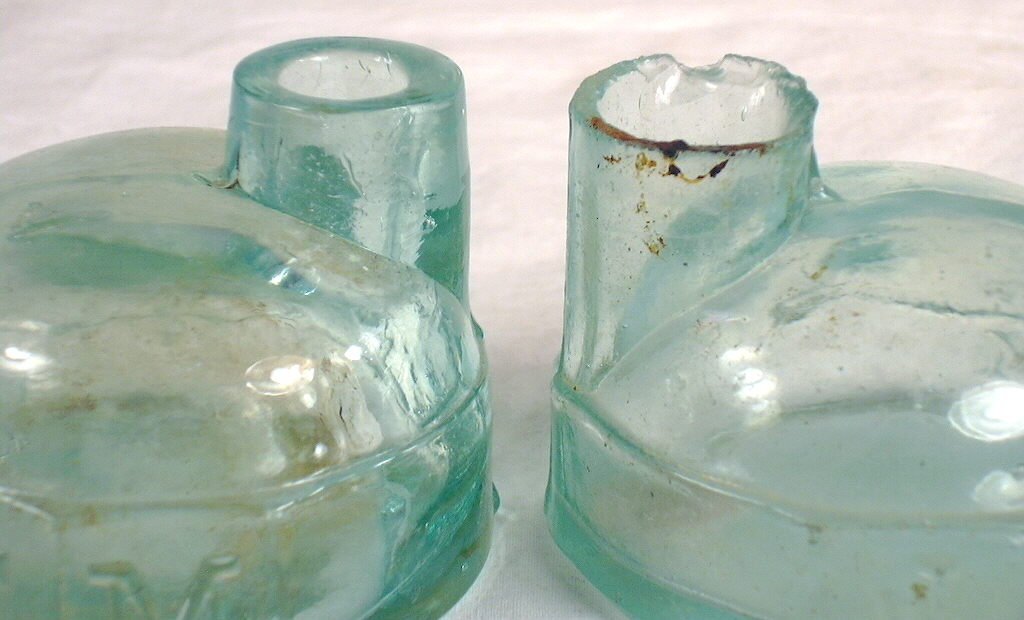
Another frequently encountered glue bottle style - although much less
commonly than the type discussed above - is pictured below
right. This
style has been called an "igloo and spout" style by collectors (Nelson
& Hurley 1967) and was also used for ink (Covill
1971). That author covered the style in his chapter entitled "Fountain
Inkwells (Misc.)" illustrating this and similar versions made by
various manufacturers (Covill 1971:307-314).
Pictured to the left is an early, embossed glue bottle of a simple style commonly encountered with glue bottles - small, cylindrical, and with a wide bore or mouth (Covill 1971; empirical observations). This early example is embossed vertically with SPAULDING'S (front) - GLUE (reverse). Although a commonly encountered mid to late 19th century bottle, this author couldn't find any history on these bottles. A quick search of the internet shows some 19th century newspaper ads for it though nothing on the company that produced the product. This bottle is approximately 3.3" tall, was blown in a true two-piece mold (the mold seam equally dissects the base), has a blowpipe pontil scar, a rolled or folded finish, and exhibits no evidence of mold air venting. All that is commensurate with the age of the bottle which was manufactured in the 1850s based on the context it was found. Several authors have noted that these bottles are commonly found on Civil War camp sites and are usually pontiled, i.e., pontil scarred through most or all the first half of the 1860s (Russell 1998; Faulkner 2009). The author has also observed later mouth-blown versions that are not pontiled, have tooled finishes, and blown in cup-base molds (empirical observations). Click on the following links to see more images of this bottle: base view showing the circular blowpipe style pontil scar; close-up of the neck and finish showing the rolled or folded style of finish - a finish rarely found on post ~1870 bottles. Glue was also packaged and sold in other bottle shapes and sizes from the mid-19th century through the end of the period covered by this website in the mid-20th century. Future additions to the site may add additional mucilage and glue bottles examples... Dating summary/notes: Generally speaking, the dating of these type bottles based on manufacturing related diagnostic features follows most of the guidelines presented throughout this website and summarized on the Bottle Dating page; see that page for more information. A few mucilage bottle specific manufacturing related diagnostic features and dating trends have been noted by the author and are discussed as follows; trends which are also common with the similar smaller (non-bulk) ink bottles:
|
Return to the top of this page.
| Blacking/Shoe Polish
Although blacking and shoe polish bottles can be square (below right), cylindrical (cylindrical utility bottle), rectangular (to the left), or more uncommonly oval (1830s oval example) or even octagonal in cross-section they tend to all share at least a couple similarities. First and foremost is a moderately wide bore or mouth - usually about 1" in diameter give or take 1/8" to 1/4". Such was necessary for the use of an application swab or sponge which was usually mounted on the end of a wire or wooden stick. (Click 1883 patent for a shoe polish bottle and applicator to see a copy of a patent for a bottle described later but which shows the typical type applicator used for shoe polish/blacking.) Documented use of such applicators began at least as early as 1829 (McKearin & Wilson 1978). The second commonality is that the capacity of the bottles were dominated by those holding about 4 to 6 ounces, although "bulk" bottles or jars as well as ones a bit smaller than 4 ozs. were also used, and many products came in bottles of that size (McKearin & Wilson 1978). However, consideration of that size along with a moderately wide bore can lead one to conclude that such a bottle could have been used for shoe polish/blacking unless strongly identified by other features or embossing as something else (empirical observations).
This square, short neck style was made in the U. S. from at least as early as the 1810s until well into the 20th century. Of course the specifics of manufacture as well as the closures and finishes used varied over that time, e.g., corks and cracked off finishes in the early 19th century to screw caps and external threaded finishes in the 1920s and after. A very common example of a late 19th to early 20th century, mouth-blown example is available at this link: Frank Millers Dressing. This aqua example from the 1890s to 1910s period shares the same general proportions and dimensions as the much early blacking/shoe polish bottles pictured to the above left, but has a tooled "patent" finish and was blown in an air vented, cup-base mold.
The images to the left are of a mid/late 1910s or (more likely) 1920s to early 1930s, machine-made example with the original label and dried up contents. One side is embossed with 5 FLUID OZ. (horizontally) at the top of the embossed side and WHITTEMORE / BOSTON / U. S. A. (vertically) below; the other side has the original label as shown (click to enlarge images). This bottle is 5.4" tall, machine-made of colorless glass on an Owens Automatic Bottle Machine as evidenced by some of the suction scar showing on the lower body of the embossed side - a common feature with earlier (pre-1940) bottles made on that famous machine. In the experience of the author, machine-made bottles like this lack the indented panel on the embossing side that is typical of the earlier (pre-mid 1910s) mouth-blown examples, though some mouth-blown examples lack the indentation also (empirical observations).
By the mid-1910s, especially as machines began to dominate production, the cylindrical style began to dominate the glass bottle shoe polish market although rectangular and square bottles continued to also be used until the mid-20th century (Illinois Glass Co. 1906, 1911, 1920, 1926; Kearns-Gorsuch Bottle Co. 1916; Owens-Illinois Glass Co. 1930). For some examples of early machine-made "shoe dressing" bottles from period bottle makers catalogs click on the following links: Illinois Glass Co. 1906 - page 282; Kearns-Gorsuch Bottle Co. 1916 - page 132; Illinois Glass Co. 1926 - page 144, 145 and 146.
As the embossing indicates, this distinctive bottle style was patented on March 6, 1883 although the patent was applied for in 1880 so examples could date back to that time at least. Click Samuel M. Bixby's March 6, 1883 patent #273,444 to see the original patent for the bottle shape - particularly the bulging shoulder - and the polish applicator (primarily the handle at the top). It noted that the patent was for "...certain new and useful Improvements in Bottles for Containing Liquid Blacking..." Although the bottles are somewhat variable, it appears that the earlier bottles are like the taller more slender example above. Later mouth-blown ones had a body that was squattier, square with rounded corners and the patent date in one line just below the shoulder bulge. Click squat example to view an image of an early 20th century example; click base view to view the base embossing of this squared example. S. M. Bixby was also a producer of inks, bluing, stove polish, mucilage and harness oil in addition to blacking/shoe polish. The company apparently began in the 1860s and continued for many years, using a variety of different bottles for the other products, until Bixby's death in 1923 when the company was sold to a competitor (Faulkner 2009) although the product name continued and was connected with the famous Shinola shoe polish. (For more information on the company view this website: http://www.glassbottlemarks.com/s-m-bixby-company-bottles/ ) Click machine-made Bixby bottle to see a 3 oz. capacity cylindrical example that likely dates from the 1910s or 1920s and is typical of that eras shoe polish bottles. Click 1919 Bixby advertisement to see such showing the same bottle shape. Shoe polish/blacking was also packaged and sold in other bottle shapes and sizes during the period covered by this website, i.e., entire 19th to mid-20th century. Future additions to the site may add additional blacking/shoe polish bottle examples...
Dating summary/notes: The dating of these type bottles based on manufacturing
related diagnostic features very closely follow the guidelines
presented throughout this website and summarized on the
Bottle Dating page; see that page for more information.
There are no significant bottle type specific, manufacturing related
diagnostic features or dating trends that have been noted by the author. |
Return to the top of this page.
|
The use of bottles for various toiletry products dates back a couple
thousand years to the Hellenic and Roman empire periods. For example,
the small (3" tall) Roman bottle to the right dating from the Judea Period,
i.e., first to second century A.D. This large but variable
class of Roman bottles are often referred to as "unguentarium
bottles" as they were commonly used for holding scented oils for the body and
hair as well as perfumes (Van den Bossche 2001). The bottle is free-blown, a light greenish
color glass, a finish that was flared with some primitive tool and has
evidence of a sand type pontil scar on the base. It is also heavily
patinated from the reaction of the soil it was found in with the glass
over almost 2000 years. Click the following links to see more images
of this ancient bottle:
side view,
base view, and
top view. As with the rest of this website, the bottles covered
largely date from the 19th to mid-20th century and were produced primarily
in the United States.
|
Return to the top of this page.
| Snuff
These type bottles were also used variably for other products (i.e., "utility bottle" - next section below) like blacking and ink (both liquid or powdered), a wide array of dry ground spices like mustard and pepper, and medicinal powders to name a few relatively common alternative uses (McKearin & Wilson 1978). Snuff bottles were also used for less processed ground or flaked tobacco (for smoking or chewing) although such products seemed to have been typically packaged in larger wide mouth jars similar to canning jars (like the Lorillard jar discussed below) and in non-glass containers made of metal or ceramic (Toulouse 1969; Creswick 1987;). As with many commercially bottled products in the 18th and 19th centuries, snuff was thought to have medicinal uses primarily for catarrh and headaches, though wilder claims were rampant until the regulatory limits imposed on such in the early 20th century (Young 1961, 1967; McKearin & Wilson 1978).
Rectangular
The tall and relatively narrow, early American, rectangular, black glass snuff bottle to the right is of a style primarily made from the late 1700s into the 1840s, at which point the next discussed style bottle became the dominant rectangular style through the rest of the century (McKearin & Wilson 1978; Van den Bossche 2001). This example is 5.25" tall, has a faint sand pontil scar, and was blown in a dip mold (slight taper from shoulder to heel, uneven shoulder height, no visible mold seams, glass surface textural difference between shoulder and body) forming the distinct body sides; the shoulder and very short neck being formed by hand. The finish appears to be a crude string style which was an early finishing process originating during the mid-17th century and little seen after the 1820s due to improved finishing technology (Jones 1986; empirical observations). This indicates that this bottle was likely made no later than that, i.e., made between about 1800 and 1825. Click on the following links to view more images of this bottle: side view; close-up of the upper body and finish to see the smooth, glossy "free-blown" and seamless appearance of the shoulder (typical of dip mold shoulders) and the very crude finish. Also click base view to see the equally seamless and crude base which has a faint, scattered sand pontil in evidence. (The faint ring in the middle of the base is simply crudeness not a pontil scar.) See Van den Bossche (2001), Plate 357, #3 for a very similar shape and size English example (with flared finish) made about 1800 and Plate 348, #1 for a similar, taller English example dated to about 1840. Similar examples of this tall style have been seen by this author to over 9" in height but with the same approximate body width and depth. These early dip molded rectangular (and square) snuff bottles were typically blown and body formed in clay molds (McKearin & Wilson 1978).
Both the pictured examples were made in full sized true two-piece "hinge" molds which formed virtually all the conformation of the bottle with just nominal tooling done at the cracking off point to form a simple flared finish. These molds were typically made of iron (McKearin & Wilson 1978). Click base view to see the blow-pipe pontil scar (the dissecting base mold seam is present but not visible in the image) as well as several mold induced indentations ("debossing") that are of unknown meaning. They were similarly produced, it appears, as the "F" on the base of the labeled example above. (Note: These "F" base snuff bottles have been attributed to Joseph Foster's South Stoddard Glass Works (or Granite Glass Co.) at Mill Village (Stoddard), NH. which would date these bottles during the years of his ownership from 1846 and 1862 [Lockhart et al. 2015ff, 2015pp; American Glass Gallery website www.americanglassgallery.com accessed 11/2019.) Various types of such "debossing" as well as embossed lines or numbers are occasionally observed on the base of these earlier, fully molded snuff bottles (McKearin & Wilson 1978). They may be glass maker specific mold markings for company use, or like the "F" snuff above, a possible or likely makers mark. It may be possible that some of these figures were early "strength" indicators like later indicated by the above noted dots? As noted earlier, these bottles are very rarely body embossed but are seen on occasion. Click E. ROOME / TROY / NEW YORK to see an image of a body embossed example that is essentially identical shaped and sized which dates from 1845 t0 possibly 1853 when Edward Roome died (McGuire 2017). It also is blow-pipe pontil scarred. Click base view to see such which also shows the typical dissecting mold seam of a two-piece hinge mold (upper right to lower left corner of the base). (Images from eBay.) On rare occasions, the typical flat chamfered corners on these rectangular snuffs are distinctly incurved; likely a purely decorative feature. (See McKearin & Wilson [1978], plate 75, #15.)
Like rectangular snuff bottles, square examples were also commonly made through all of the 19th century and into the mid-20th century. In the experience of the author, however, rectangular snuff bottles were more commonly used in the 19th century than square ones with that reversing in the 20th century where square bottles seemed dominant (empirical observations). For example, only one style of snuff bottle was offered in the 1906 Illinois Glass Company catalog and it was square. See IGCo 1906 catalog page 106 - which is completely scanned and posted on this website - offering it in four sizes: 2, 3, 4 & 6 oz. capacities. (Note: The author has never actually seen the two smaller sizes indicating they were uncommonly used?) The very early American, olive amber snuff bottle pictured to the left possibly dates from as early as the late 18th century to as late as about 1830 (McKearin & Wilson 1978). It, like the first rectangular snuff discussed above, was blown in a dip mold to form the shape of the body with the portions above the top of the sided body "free-blown" like all dip molded bottles although such work was usually assisted with the use of various simple hand tools used by the blower. This example is about 5" tall, has rounded but not chamfered corners, and a blow-pipe type of pontil scar on the base. (Photo courtesy of Glass Works Auctions.) See Plate 269, #1 of Van den Bossche (2001) for a similar American made example which the author dated between 1800 and 1820.
It, like the slightly earlier square snuff above, was blown in a one piece dip mold resulting in the absence of any mold seams on the base, body or shoulder. It also has a smooth, polished look to the entire body and shoulder inferring that it may have received overall fire polishing which could have removed evidence of any mold seams if they were present. During fire polishing the bottle would have been held by the pontil rod at the opening to the glass furnace or at a "glory hole" if made towards the end of the noted manufacturing period. This would have resulted in the base being away from the intense heat and not receiving little if any polishing which could have "erased" a base mold seam. Close inspection of the base shows no evidence of a base mold seam, which in hand with the slight taper inwards from shoulder to base (visible in the image), is added evidence that the bottle was indeed dip molded.
An example of the original labeling on these type machine-made snuff bottles from the first half of the 20th century can be seen by clicking Garrett's Rappe Snuff original label. Some of the Levi Garrett & Sons snuff products (moist and dry snuff) are still produced - some with the Garrett name - by the American Snuff Company. It is unknown what glass company or companies made these bottles although they are commonly encountered on 20th century historic sites. Garrett was the likely user of the above pictured bottles, though without the labels, it is impossible to say now. Cylindrical
Like several of the earliest snuff bottles already discussed, this bottle was blown in an open top, likely one piece dip mold to form the basic body shape. This is evidenced by a total lack of mold seams (and is too early to have been turn-molded) and a subtle glass thickness discontinuity just below the shoulder; the latter a manufacturing related diagnostic feature that is much more evident on cylindrical bottles than on square/rectangular dip molded bottles (empirical observations). There is a blowpipe type pontil scar within the domed base, the base being indented by the pontil rod head being attached and pushed inwards while the hot glass was still plastic and pliable. Click base view to see such. This bottle - really a very small jar at 4.75" tall - also has a bead type finish, this one likely formed by reheating the cracking-off point and down-tooling that glass with a jack or something as simple as an iron nail.
The jar has a glass lid that screwed into place with the help of a wire retainer ("ring-clamp"). Click close-up of the upper body, shoulder and closure/cap to see such. The lid is embossed around the outside perimeter with AMERICAN SNUFF CO. OF NEW JERSEY - PAT JULY 16 1872. Inside that embossing is PATENTED JANUARY 18 1876. Click view of the lid embossing to view the embossing. The following is from the The Cohansey Companies article (also linked below) explaining the closure patents: "Charles G. & William L. Imlay received Patent No. 129,235 for an “Improvement in Fruit-Jars” on July 16, 1872. The jar finish had two “screw threads or inclines” to allow the cap to screw onto the finish. The glass camp had a “groove or recess in[side] the cover.” A “metallic ring, preferably of galvanized steel” formed a “ring-clamp” with two “downward-bent hook[s]” was fitted into the groove around the side of the lid, where the hooks screwed into the finish. Although the invention was used extensively by Cohansey, the Imlay's never assigned the patent to the glass house. "On October 25, 1875, Thomas Hipwell applied for a patent for an “Improvement in Fruit-Jar Clamps. He received Patent No. 172,316 on January 18, 1876 and assigned it to the Cohansey Glass Mfg. Co. (Figure 6). This was an improvement on the Imlay patent of 1872. The main improvement was the formation of two additional hooks that clamped the wire device onto the glass lid, eliminating the need of the groove in the side of the lid. This became known as the “Hipwell-style” lid or the “Cohansey closure.” According to Roller (1983:90), “the Cohansey closure was very popular with the packer trade, and numerous variations of specially-embossed Cohansey closure jars may be found.” These closures with four “hooks” became the main Cohansey lid." (Lockhart et al. 2014u:329-330) This jar was used by the P. Lorillard Company which included the American Snuff Company sometime from 1911 on for some years (Lockhart et al. 2014u). The fascinating history behind these jars - which included many mouth-blown variations - is beyond the scope of this section. If interested, a comprehensive history of the array of Lorillard/American Snuff Co. jars is available on this website as a part of "Encyclopedia of Manufacturers Marks on Glass Containers," i.e., the article on The Cohansey Companies, p. 353-362. That article also notes that this examples lid is likely not original to the jar; the jar dating from 1911 or after and the lid dating from 1900 to 1911. During the era covered by this website hundreds if not several thousand of variations on the above discussed bottle types, as well as other styles used for snuff, were produced by glass makers in just the U. S. Coverage of even a small percentage of the plethora of types is not possible, of course, though the following includes some additional images/information about a few other styles/types to show some of that additional variety:
Dating summary/notes: Snuff bottles are quite commonly found on 19th to early 20th century historic sites - historic proof of the power of tobacco to be addicting - and are often an excellent bottle/fragment to find that assists in the dating of that site. Fortunately, the dating of these type bottles based on manufacturing related diagnostic features very closely follow the guidelines presented throughout this website and summarized on the Bottle Dating page; see that page for more information. There are no significant bottle type specific, manufacturing related diagnostic features or dating trends that have been noted by the author.
One type specific, non-manufacturing based dating
feature is the noted strength dots embossed on the base of later mouth-blown
snuff bottles and a large majority of machine-made ones. Specifically, the dots first seem to appear after the
American Civil War, i.e., 1870s or so (rectangular example noted earlier).
They are, in the experience of the author, never seen on earlier snuff
bottles - those that were dip molded or pontil scarred. They are
sporadically seen on mouth-blown snuffs from the 1870s to early 1900s and
almost always seen on square machine-made ones dating after about 1910. (Not sure about
rectangular machine-made snuffs; more study needed.) |
Return to the top of this page.
|
Utility bottles
Bottle makers catalogs from the the early to mid-19th century are essentially non-existent. All the more or less available ones are from the very late 1800s (the author's earliest is an 1879 Whitall, Tatum & Co. copy) up to the mid-20th century cut-off point for this website. The common term during the last quarter of the 19th century for what appear to be "utility bottles" were "packing bottles" or simply "packers" (Whitall, Tatum & Co. 1879, 1924; Illinois Glass Co. 1899, 1926; Kearns-Gorsuch Bottle Co. 1916; others). It is assumed those terms predate those catalogs as glassmaker terminology and were used back as far as commercial products were being bottled during the mid-19th century, if not before (McKearin & Wilson 1978). One early 20th century bottle catalog (Illinois Glass Co. 1906) narrowed down their individual listings of packing bottles with qualifiers like "Druggist' Packing Bottles (bulk pharmaceuticals/chemicals," "Flint Packing Bottles (flint=colorless glass which was popular for food products so the customer could see the goods)," heavier glass "English Packing Bottles" (in green or amber), and a wide array of "Pickle and Preserve Ware" which didn't have "packer" or "packing" in the names, though the food section noted that they "...commend these pages of our Catalogue to all Bottlers of Food Products...", i.e. commercial packing companies. The catalog notes that those packers could be purchased in sizes ranging from 4 ounces to a two gallons in "narrow" or "wide" mouth versions. For simplicity I will just use the term "utility bottles" in this section. The term utility bottles typically pertains to cylindrical bottles that were used for a variety of products as dictated by the purchaser/user of the bottle. Such bottles could have narrow to moderately wide bores (mouth) with liquid products being bottled in the narrow mouths and viscous (e.g., syrup, oils), semi-solid (e.g., blacking, powdered products), granular (e.g., salts, spices), or even solid but small products (e.g., olives, other preserved foods) in the wider bore types. Generic bottles - meaning here multi-product use in nature based on the needs of the purchaser (user, bottler, packer) - by definition have no identifying embossing or other permanent markings (e.g., applied color labeling, acid etching) on them identifying the contents. Instead, they were paper labeled by the user as to the contents contained therein. In the absence of the original label (and contents), identifying marking features (e.g., a branded closure of some type), or reliable context where found (unusual with excavated items) the exact use of the bottle can't usually be determined. Utility bottles were also not of a shape exclusively used for or strongly identified with one particular product (e.g., soda, beer, milk). Utility bottles were simply bottles commonly used for many purposes though virtually always for non-carbonated products which demanded heavier glass and more secure and/or complicated closures. (Re-use of bottles during the 19th and early 20th centuries is not discussed here as about any bottle could be reused as a utility bottle.)  The
two small (approx. 6" tall and 2" in diameter) utility bottles to the left are from the pre-Civil War era, dating from
between the 1830s and 1850s. Both are generic
utility bottles commonly used during the noted period. So without
a
label identifying the actual use one can never know for sure although
these type bottles were used very commonly for ink though neither has
a pour spout which is common on bulk inks. Click on
early, pontiled utility bottle with an ink label to see a very
similar bottle clearly used for ink. Click on the following
links to see more images of the two illustrated bottles:
base view showing the blow-pipe pontil scars and
two-piece "hinge mold" production as evidenced by the mold seam
equally dissecting the base (not totally visible in the linked image);
close-up of the shoulder, neck and finishes showing the short,
squatty mineral type applied finishes without pour spouts. Both
these bottles are typical of the utilitarian items produced by many of
the earlier New England and Midwestern glass houses during the 1820s
to 1850s period. (Also see the
Bulk Ink section of this page.) The
two small (approx. 6" tall and 2" in diameter) utility bottles to the left are from the pre-Civil War era, dating from
between the 1830s and 1850s. Both are generic
utility bottles commonly used during the noted period. So without
a
label identifying the actual use one can never know for sure although
these type bottles were used very commonly for ink though neither has
a pour spout which is common on bulk inks. Click on
early, pontiled utility bottle with an ink label to see a very
similar bottle clearly used for ink. Click on the following
links to see more images of the two illustrated bottles:
base view showing the blow-pipe pontil scars and
two-piece "hinge mold" production as evidenced by the mold seam
equally dissecting the base (not totally visible in the linked image);
close-up of the shoulder, neck and finishes showing the short,
squatty mineral type applied finishes without pour spouts. Both
these bottles are typical of the utilitarian items produced by many of
the earlier New England and Midwestern glass houses during the 1820s
to 1850s period. (Also see the
Bulk Ink section of this page.)
During the era covered by this website there were many thousands of types and variations of utility bottles produced by glass makers in just the U. S. Coverage of even a small percentage of these types is not possible, of course, though the following includes some additional images/information about a few other styles/types to show some of that additional variety:
Dating summary/notes: Generally
speaking, the dating of these type bottles based on manufacturing
related diagnostic features follows quite well the guidelines
presented throughout this website and summarized on the
Bottle Dating page; see that page for more information. |
Return to the top of this page.
|
Cleaning products Cleaning products include ammonia, Clorox®/Purex® (bleach), furniture polish, bluing, and many other products. These could also be considered as "poison" bottles to some extent as most cleaning substances are such - poisonous. (Authors note: Although some of the bottle shapes covered below were certainly used for the noted products, many of these types were generic in nature and certainly could have been used for other chemicals and pharmaceutical products. Similar bottles are additionally covered on the Medicinal/Chemical/Druggist Bottles typology page under the "Poison & Chemical bottle styles" section and in the Utility bottles section above.)
|
Return to the top of this page.
|
Other household bottles This section may be expanded in the future (e.g., pesticide/bug killer products, others?). For now only a few commonly encountered machine oil bottles will be addressed.
|
Return to the top of this page.
|
For additional images of various labeled household bottles click the following link to view the pertinent section of the Labeled Bottles page. |
Again it must be stated that the category of bottles covered on this webpage (Household Bottles [non-food related]) is extremely large and very diverse. Like all of the bottle "typing" (typology) pages connected to the main Bottle Typing/Diagnostic Shapes page, this page just scratched the surface as to the total diversity of these bottle types. It does, however, cover some of the primary styles that were most commonly used and encountered within an archaeological context. This page has also somewhat emphasized mouth-blown bottles since that subject is of more familiarity to the author of this website than later 20th century, machine-made items. Although the automated bottle production era also had incredible variety, it was not as diverse as the mouth-blown era since shape standardization and simplification was typical of machine manufacturing. Also, bottle body embossing became much less frequent on machine-made bottles and a significant amount of the diversity of the mouth-blown production era was the different proprietary embossing on essentially the same shapes of bottles.
SEARCHING THIS WEBSITE:
To do a word/phrase
or image search of this website
one must use the following Google search link:
Search the SHA/BLM Historic Glass Bottle Identification & Information
Website
(Note: Search results for this website will be just below the
final top-of-the-page Google paid ads.
12/5/2022
Return to the top of this page.
This website created and managed by:
Bill Lindsey
Bureau of Land Management (retired) -
Klamath Falls, Oregon
Questions? See
FAQ #21.
Copyright © 2022 Bill Lindsey. All rights reserved. Viewers are encouraged, for personal or classroom use, to download limited copies of posted material. No material may be copied for commercial purposes. Author reserves the right to update this information as appropriate.




 L.
H. Thomas labeled cone ink
L.
H. Thomas labeled cone ink BILLINGS
/ MAUVE INK
BILLINGS
/ MAUVE INK
 "Drape
pattern" cone style ink
"Drape
pattern" cone style ink


 Large
"carmine" style ink bottle
Large
"carmine" style ink bottle English
burst-off finish rectangular ink
English
burst-off finish rectangular ink


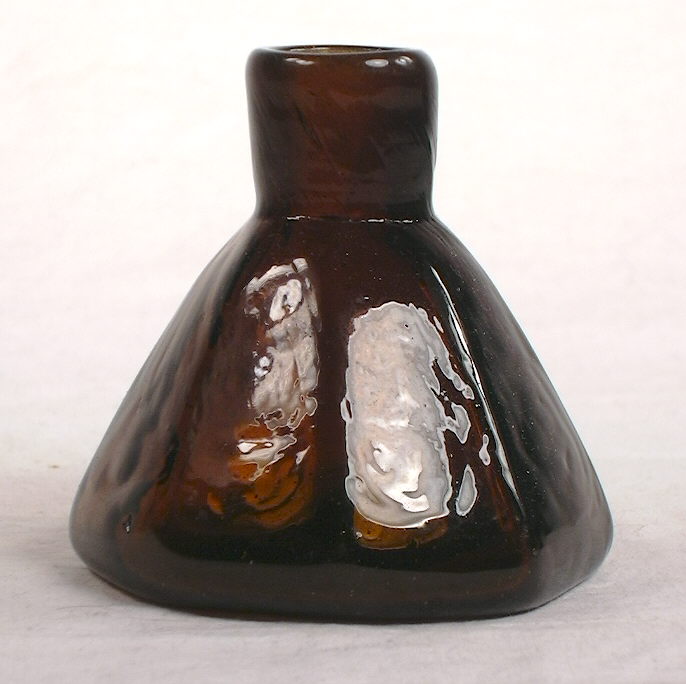
 Green
umbrella ink with distinct shoulder
Green
umbrella ink with distinct shoulder
 HARRISON'S
/ COLUMBIAN / INK
HARRISON'S
/ COLUMBIAN / INK
 HARRISON'S
/ COLUMBIA / INK
HARRISON'S
/ COLUMBIA / INK
 DAVID'S
igloo ink
DAVID'S
igloo ink


 "Classic
Oblong" style drug/chemical bottle
"Classic
Oblong" style drug/chemical bottle SOLON
PALMER PERFUMER / 3 FL. OZ. N.Y.
SOLON
PALMER PERFUMER / 3 FL. OZ. N.Y.

 The
bottle pictured at the top of this section (again to the far left) is one of the earliest examples of what was at that time becoming by
far the most popular brand of Florida Water in the U. S. and probably the
world - Murray & Lanman's Florida Water. It is still
being produced today in several bottle sizes (regular size shown in
the image to near left). The label similarity between the
two is striking given the 160 years separating them! The stated capacity
on the current product is 7.5 oz. - also about the same as the
earlier size. Certainly part of this
companies success was probably due to the companies extensive use of
advertising in the form of trade cards. Below right is one of
scores of different advertising trade cards the company gave away; one
that shows the bottle embraced by flowers and gazed upon by a
cockatoo. This card probably dates from the 1880s; the back side
gives a litany of uses including simply as a "...floral
perfume for the handkerchief..." but also that it "...relieves
headache, promotes sleep, allays nervousness, is a rare disinfectant
for the sickroom, exhilarates the sprits..." among many other
attributes. Click
The
bottle pictured at the top of this section (again to the far left) is one of the earliest examples of what was at that time becoming by
far the most popular brand of Florida Water in the U. S. and probably the
world - Murray & Lanman's Florida Water. It is still
being produced today in several bottle sizes (regular size shown in
the image to near left). The label similarity between the
two is striking given the 160 years separating them! The stated capacity
on the current product is 7.5 oz. - also about the same as the
earlier size. Certainly part of this
companies success was probably due to the companies extensive use of
advertising in the form of trade cards. Below right is one of
scores of different advertising trade cards the company gave away; one
that shows the bottle embraced by flowers and gazed upon by a
cockatoo. This card probably dates from the 1880s; the back side
gives a litany of uses including simply as a "...floral
perfume for the handkerchief..." but also that it "...relieves
headache, promotes sleep, allays nervousness, is a rare disinfectant
for the sickroom, exhilarates the sprits..." among many other
attributes. Click


